
Your Basket is Empty
Email shop@aurina.co.uk for bespoke advice

Last Updated: November 6, 2026
Quick Summary
The best independent boutiques for interior design are owner-run shops that buy their own stock in small runs, so you get hard-edited ranges and honest advice rather than a national buying plan. Look for a defined point of view, provenance you can question and staff who will talk through scale and pairing.
Independent boutiques are small, owner-run shops that select their own stock rather than following a national buying plan. That single difference changes what you find inside: fewer lines, chosen by a person who has to live with the consequences of getting it wrong.
Still, the mechanics are plain. A high street chain buys in volume and spreads risk across hundreds of stores. An independent retailer buys in small runs and carries the risk itself. The result is a shop where the lampshade on the shelf was chosen because someone thought it was good, not because a spreadsheet said it would shift.
What most guides miss is that curation is a skill, not a mood board. A good independent boutique edits hard. It turns down far more than it takes, and that refusal is what you are paying for.
Most round-ups of independent interiors shops never tell you how the list was built. Ours does, because a recommendation is only as useful as the method behind it.
Price band matters as much as taste, and it is worth asking a boutique to explain what drives its prices. If it cannot explain why a cushion costs £46.95 rather than £12, that is your answer about what you are paying for.
UK government guidance on misleading pricing and price claims sets out what retailers may and may not claim about value, which is worth knowing before you accept a "was" price at face value. A genuine independent should be comfortable with the question.
When choosing a boutique, it is worth asking about aftercare. Can the piece be cleaned, repaired or replaced? Does the shop offer fabric samples or a returns route?
Walk into a good independent homeware shop and the first thing you notice is restraint. One table, six objects, space between them. Compare that with a chain where forty cushions compete for the same metre of shelving.
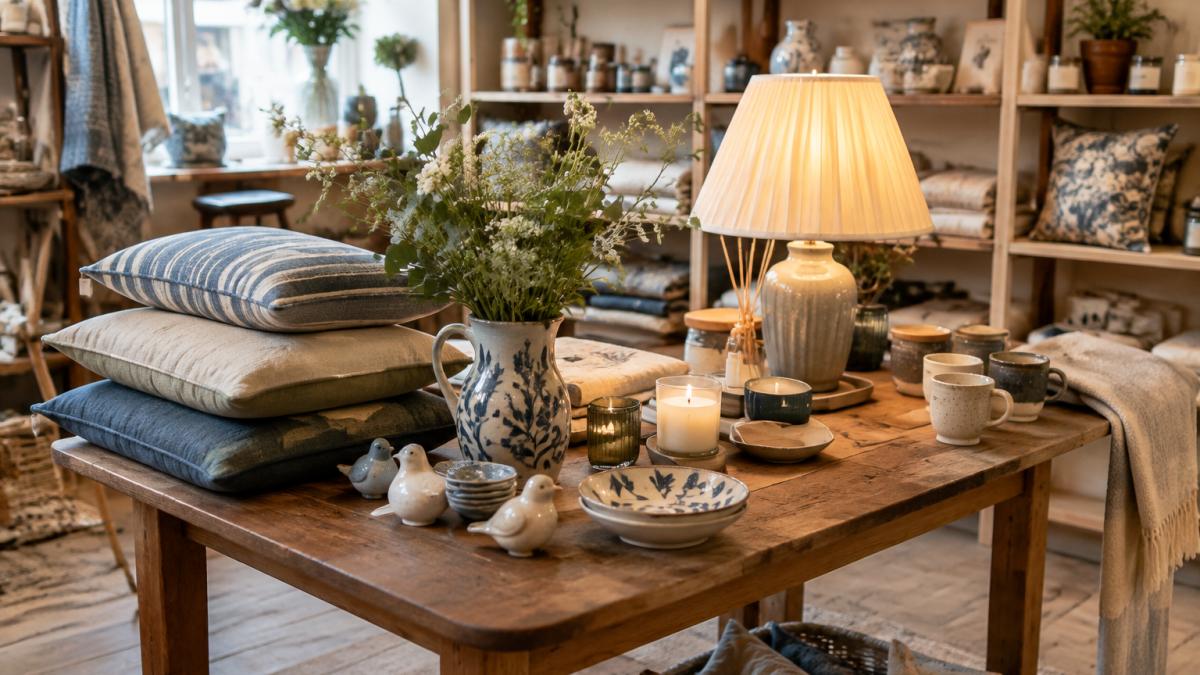
Curation beats volume for three practical reasons. You can see how pieces work together, because someone has already done the pairing. You get honest guidance on scale, because the shop is small enough that the staff know each item. And you avoid the strange experience of walking into a friend's house and finding your entire living room already there.
The trade-off is real. Independent homeware shops cannot stock every size, every colourway and every finish. You may wait for a made-to-order piece. That wait is usually the point.
Provenance answers a question volume retail cannot: who made this, and where? British homeware brands that design and manufacture domestically can usually answer it in a sentence, which changes how you value the piece.
Knowing where a cushion was made and who made it can matter if you later need a repair or replacement.
Take the Starling Dusty Blue Cushion, £46.95: a cotton and linen base, 50x50cm, supplied with a micro down inner pad made from synthetic feathers.
Lighting tells the same story. The Green Tapered Harvest Lampshade is £125, in 100% cotton with floral embroidery. The Pushpa Pleated Lampshade starts at £60 in Raspberry, Teal or Natural, with a hand-finished trim. Pair either with the Hedra Ceramic Moss Lamp Base, a 100% stoneware piece at £250.


If you want to build a scheme this way, our guide to choosing bespoke lampshades for a cohesive interior walks through the pairing decisions step by step, and you can order bespoke cushions made to order when you know the fabric you want.
Green Tapered Harvest Lampshade →
Wallpaper is the category where independent brands earn their keep, because pattern is the hardest thing to get right from a screen.
Weighing up whether the spend is justified? Our piece on whether sustainable wallpaper is worth the cost sets out the trade-offs plainly, including where a cheaper paper genuinely does the job.
A useful order for deciding is room first, then style, then budget, then logistics. Room affects scale and suitability, style narrows the palette, budget decides whether to buy the statement piece now or later, and logistics covers whether you can get it home.
| Filter | Question to ask | What it rules out |
|---|---|---|
| Room | Where will this live, and how much light does it get? | Oversized shades, delicate fabrics in busy halls |
| Style | Does it sit with what you already own? | Trend pieces that fight your existing scheme |
| Budget | Is this the statement piece or the filler? | Buying three mediocre items instead of one good one |
| Lead time | Can you wait for made to order? | Last-minute purchases before a deadline |
| Delivery | Does the shop ship, offer click-and-collect, or is it visit-only? | Assuming a piece is available when it is collection-only |
| Aftercare | Can it be cleaned, repaired or replaced? | Pieces that fail once and are finished |
Price bands help narrow the field before you travel or click. A £46.95 cushion and a £250 ceramic lamp base are not competing for the same budget line, and treating them as if they are can stall a scheme.
If you are buying remotely, check whether the shop offers fabric samples, whether made-to-order items are returnable, and whether click-and-collect is available.
It is worth checking opening hours and access before a visit. On provenance, ask whether a piece is made in Britain or merely designed here, as the two are not the same claim.
If you are not confident applying that filter on your own, personalised interior design advice for beginners is the shortcut: it takes your room, taste and budget as the starting point rather than asking you to arrive with a fully formed vision. The filter above is what that conversation will work through, in order, until the shortlist is small enough to act on.
You do not need a mood board or a decided colour scheme to start a conversation with us. Many people begin with "I like this room but I don't know why", and we can work backwards from there.
At Aurina, we offer bespoke interior design and custom product services alongside our British design-led home textiles, wallpapers and home fragrance. If you are ordering remotely, that advice works the same way by email or phone as it does across the shop counter. A good example of where a conversation helps is the Vintage Style Denim Floral Block Print Cushion, a piece that reads very differently against a neutral wall than against pattern.
You can also see the range in person, including pieces like the Cley Wall Light Brick Pink at £75 and the Moss Green Ceramic Artichoke at £59.95, or book a bespoke interior consultation at Aurina and bring the room, the budget and the doubt. We will take it from there.
A useful test of any independent boutique is whether the person serving you will talk you out of something.
Look for a clear point of view rather than a warehouse of options. The best independent boutiques can tell you who made a piece, in what material, and why they chose it. Ask about provenance, whether the shop offers bespoke or made-to-order services, and how returns work if a colour does not suit your room. A boutique that stocks British homeware brands and can advise on scale and placement is worth more than one that simply sells decor.
Often yes, and the gap reflects what you are buying. A mass-market cushion and a British-made home textile may look similar online, but they can differ in where and how they are made. The listed prices include a cushion at £46.95 and a lampshade at £60, so entry prices are not out of reach. Judge cost per year of use, not the sticker price alone.
Ask directly and expect a specific answer. It is reasonable to expect a clear answer about where a product is made and which parts, if any, are assembled elsewhere. Vague claims about British design are not the same as British manufacturing. When you shop, check whether the listing states materials and dimensions, and ask the boutique to confirm where the piece is produced before you order.
Yes, provided the boutique offers it. Ask whether the boutique can advise on sizes and options before you commit. For lighting, a quick photo of your lamp base and a note of the shade diameter you need prevents most mistakes. Confirm delivery times for made-to-order and pre-order items too, as these can take longer than standard stock.
Independent interiors reward the buyer who asks questions rather than the one who browses fastest. If you want a scheme built around your own rooms instead of a catalogue page, get started with Aurina and book a bespoke consultation with our team.
Comments will be approved before showing up.
