
Your Basket is Empty
Email shop@aurina.co.uk for bespoke advice

Last Updated: 19 October 2026
Personalised interior design is the practice of shaping a room around how you actually live, rather than around whatever look is trending on social media this month. At Aurina, we see the difference constantly in our Norfolk shop: rooms that feel like their owners, and rooms that feel like a showroom.
Most beginners start with a style label. "I'm doing Scandi." "I want maximalist." That is backwards. A style label is a shortcut, and shortcuts skip the one step that makes a room feel personal: noticing what you already love.
Try this before you buy anything:
That last step matters more than any mood board. As the Royal Institute of British Architects' guidance on home design puts it, good design starts with how people want to live, not with a fixed look.
Below, we'll show you exactly how to turn that self-knowledge into a room, from mood boards to pattern mixing, without losing your nerve halfway through.
A mood board for interior design is a single place where you gather colours, textures, images and samples that capture the feeling you want in a room. Physical boards work better than digital ones for beginners, because you can hold the fabric and see how the light hits it.
Here's our simple method:
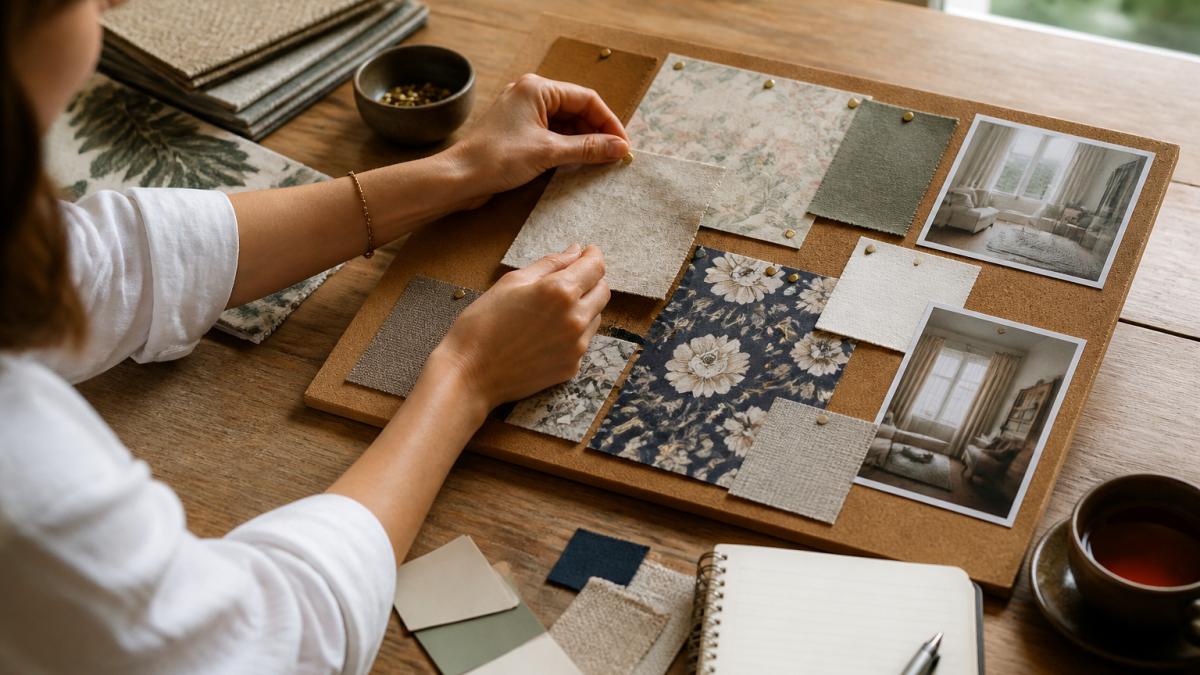
Choosing a colour scheme for a room comes down to three decisions: a dominant colour, a secondary colour, and one accent. Beginners fail because they try to make every colour equally important.
Use the 60/30/10 rule as your starting point:
| Role | Share of the Room | What It Covers | Example |
|---|---|---|---|
| Dominant | About 60% | Walls, large furniture, flooring | Soft off-white or warm stone |
| Secondary | About 30% | Curtains, sofa, rug, bedding | Dusty blue or sage green |
| Accent | About 10% | Cushions, lampshades, small art | Bright pink or mustard |
Buy tester pots and paint large patches of card, not the wall. Move the cardboard around the room over a few days and watch it at morning and evening. Then commit.

The second-guessing usually comes from too many options, not too few. Narrow to two schemes and pick the one that matches your one-word feeling from earlier. If you want "calm", the softer scheme wins. Every time.
Mixing patterns in interior design works when you vary scale and keep one element constant. A small floral next to a large stripe looks deliberate. Two small florals next to each other look like a mistake.
Our rule of three:
Then tie them together with a shared colour. If your cushion patterns all contain a thread of the same dusty blue, they will sit happily together even though the designs are completely different.
Annie Sloan's Room Recipes For Style and Colour →
For a country look, start with a floral, add a stripe in the same colour family, and finish with a plain linen cushion. Our Starling Dusty Blue Cushion at £46.95, for example, is printed on a cotton and linen base and works as the calm, plain-textured layer that lets bolder patterns breathe.
The interior design mistakes to avoid are rarely about taste. They are about sequence. Beginners buy the fun things first, then discover the room has no anchor.
Watch for these:
That last point is the one we hear about most from customers who have been burned ordering online. It is also the easiest to fix: ask for a sample before you commit to a fabric or wallpaper.
Personalised interior design advice for beginners comes from three places: books that teach you to see, samples you can touch, and real rooms you can walk into. All three beat scrolling.
Books are underrated. A good one gives you a vocabulary for what you already like. Annie Sloan's Room Recipes For Style and Colour (£25.00) examines nine key interior styles with 300 photographs and practical tips for developing your own look, which is exactly the right starting point for a beginner. Perfect English Style (£45.00) goes further, exploring how patina, fabrics and vintage pieces create character, and why English style is relaxed rather than prescriptive.

Samples come next. Fabric and wallpaper behave differently in your own light, and no screen fixes that. At Aurina, we offer custom fabrics and cushions and one-off pieces made to order, so you can build a scheme around a sample rather than hoping a photo was accurate. Our team will talk you through options remotely if you can't visit in person.
Real rooms finish the job. Visit a shop, a friend's house, a National Trust property. Notice what you notice. That reaction is your taste talking.
The Design Council's work on design quality in the built environment makes a related point well: good design is judged by how a space works for the people in it, not by how it photographs.
Decorating a room from scratch is daunting, and the fear of getting it wrong stops more people than any budget ever does. At Aurina, we take that fear seriously. We're an independent boutique with a curated selection of British design-led home textiles, wallpapers and accessories, and we offer personalised shopping advice, access to custom fabrics and cushions, and one-off interior pieces made to order. Come and see us, or get in touch remotely, and we'll help you build a room that feels like you. Subscribe to hear when new pieces arrive.
Start with one room and one feeling. Spend a week collecting images of rooms that make you feel calm, energised or at home, then pin them together and look for repeats: the same warm neutrals, the same natural textures, the same low-slung furniture. That pattern is your starting point. From there, pick a colour scheme of two or three tones, choose one patterned piece you love, and build the rest of the room around it. You do not need a full plan before you buy anything; you need a direction you can test.
Keep one pattern as the lead and make everything else quieter. A common approach is one large-scale motif, one small-scale motif and one stripe or check, held together by a shared colour that appears in at least two of them. Vary the scale deliberately: a big floral next to a small geometric reads as considered, while two medium florals fight each other. Give patterned pieces breathing room too. One patterned cushion on a plain sofa does more than four competing prints, and you can always add a second once the first feels settled.
The most common ones are buying furniture before deciding a layout, painting a whole room from a tiny colour chip, and hanging artwork too high. Others include pushing every piece against a wall, ignoring lighting until the end, and buying a full set of matching furniture in one go, which leaves a room looking like a showroom rather than a home. Measure the room, mark out furniture positions with tape, and test paint samples on the actual wall for a few days before committing.
Yes. Independent boutiques routinely advise remotely by email, phone or video, and many will post fabric and wallpaper samples so you can see colours in your own light before ordering. Send photographs of the room taken in daylight, along with measurements and a note on what you want the space to do. Ask specifically for swatches of anything you are considering, and check the returns policy for made-to-order pieces before you commit, since bespoke items are often excluded from standard returns.
Comments will be approved before showing up.