
Your Basket is Empty
Email shop@aurina.co.uk for bespoke advice

Last Updated: November 5, 2026
Quick Summary
Choose handmade woven rugs for living spaces by matching the fibre to the room: wool is the most forgiving choice for busy lounges, while cotton suits casual corners and jute handles heavy footfall in hallways. Measure your furniture footprint rather than the room so the rug sits under the front legs of every seat, and add a good underlay on hard floors.
A handmade woven rug is a floor covering produced on a hand-operated loom, where a weaver interlocks each weft thread by hand rather than a machine punching yarn through a backing. You can browse our handmade rugs for living rooms to see the range available to buy.
Below, we explain exactly how to choose one, from fibre and construction through sizing, colour and care, so you buy a rug you keep for a decade rather than a season.
Many buying guides treat handmade rugs as a decorative upgrade, but a handwoven rug is also a decision about how a room sounds, feels and wears, and getting the fibre and size right matters as much as the pattern.
Natural fibre rugs are woven from animal or plant yarns rather than synthetic filament, and each fibre behaves differently underfoot, in sunlight and under a vacuum. The fibre you choose decides the rug's softness, its durability and how forgiving it is when something spills. Most buying guides list the fibres without explaining the trade-offs, so here is a fibre-by-fibre comparison based on how each performs in a lived-in lounge.
Wool is the default choice for a lounge, and rightly so. It holds dye deeply, resists flattening under furniture, and has a natural springiness that makes a seating area feel warmer underfoot in winter. Wool fibres have a crimp that traps air, which is why a wool rug feels warmer than a flat cotton or jute piece of the same thickness.
A common mistake is buying a thin wool rug for a high-traffic family room; look for a denser weave with a visible pile. Expect loose fibres to shed for the first few weeks, which is normal and settles with regular vacuuming. In busy households, wool is the most forgiving natural fibre overall, but it does not like prolonged damp, so blot spills promptly and avoid washing a full wool rug at home.
Cotton is the practical choice for washable, lightweight rugs and works well in casual seating corners. It is softer underfoot than jute but less resilient than wool, so it flattens faster in doorways and in front of a sofa. Cotton accepts dye well and is often used for flatweaves and printed-look designs. Small cotton pieces can be machine washed, and the care label should be checked first. The trade-off is that cotton has little natural stain resistance, so treat spills immediately and avoid leaving a damp cotton rug on a hard floor.
Jute brings a rougher, matte texture that suits a natural, pared-back look but is less comfortable as a barefoot surface. It is one of the most durable natural fibres and handles heavy footfall well, which makes it a sensible choice for a hallway or an open-plan area where a softer rug would wear quickly. Jute is not very stain-resistant and does not tolerate prolonged damp, so it is best kept out of bathrooms and kitchens. It also sheds slightly at first and can feel scratchy underfoot, so many people layer a smaller wool or cotton rug on top for comfort.
Silk adds sheen and fine detail, usually in smaller accent pieces rather than a main lounge rug, because it shows wear faster in high-traffic spots. Silk is soft and takes dye with great depth, which is why it appears in fine traditional patterns. It is the least durable of the four for everyday seating use and is best reserved for a low-traffic corner or a decorative layer. Silk generally requires specialist cleaning.
| Fibre | Softness underfoot | Shedding | Stain resistance | Maintenance | Busy households |
|---|---|---|---|---|---|
| Wool | High | Moderate at first | Good | Vacuum low suction, blot spills | Best overall |
| Cotton | Medium | Low | Low | Machine wash small pieces | Good for casual use |
| Jute | Low | Slight at first | Low | Vacuum, keep dry | Good for hallways |
| Silk | High | Low | Moderate | Specialist clean only | Not recommended |
Our Peruvian rugs are hand woven from authentic wool, come in a range of colours, and are around 140cm square on average.

The woven cotton rug or bath mat is finished with white tassels.
To choose a rug size, measure the footprint of your furniture, not the room: the rug should sit under the front legs of every seat in the grouping, or under all four legs if the room allows. A rug that floats in the middle of a lounge, touching no furniture, makes even a generous room feel smaller.
A practical sizing guide:
| Room layout | Suggested rug footprint | Furniture placement |
|---|---|---|
| Compact lounge | 120 x 170cm | Front legs of sofa and chairs on the rug |
| Standard seating area | 160 x 230cm | All front legs on, back legs off |
| Large lounge | 200 x 290cm | Entire seating group on the rug |
| Open-plan | Two rugs zoned by function | One under seating, one under dining |
| Hallway or galley space | Runner, 60-80cm wide | Centred with even floor margins |
In a compact room, a slightly smaller rug that still catches the front legs of the sofa beats an oversized one that swallows the floor. In an open-plan layout, use two rugs to zone the seating area from the dining or kitchen space rather than one vast rug that blurs the boundary. A rug runner works well in narrow passages and beside a bed, where a full-size rug would crowd the walkway.
Warmth in a lounge comes from layered texture and a restrained palette far more than from a bold print. Start with a base tone drawn from your largest surface, usually the sofa or floor, then add one warmer accent through the rug.
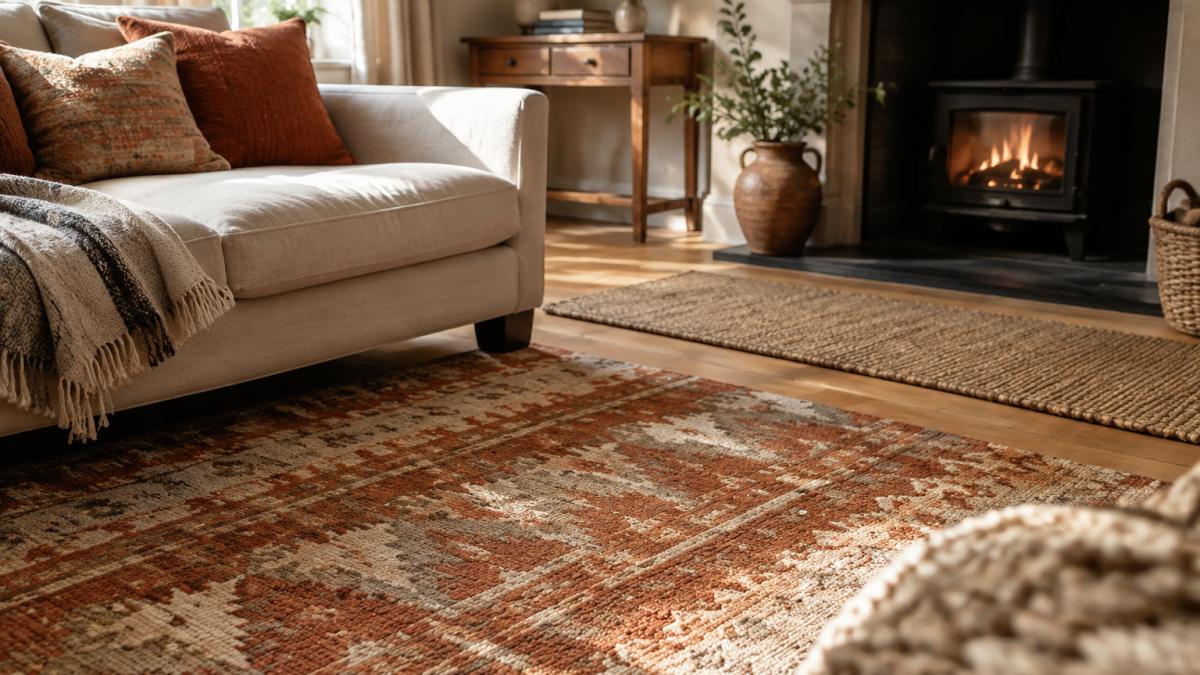
A handwoven rug carries colour differently from a printed one because the yarn is dyed before weaving, so the tone has depth rather than sitting flat on the surface.
Caring for a wool rug comes down to three habits: vacuum without the beater bar, rotate the rug twice a year, and deal with spills immediately by blotting, never rubbing. Wool is naturally stain-resistant on the surface, but liquid pushed into the pile is far harder to lift. The same principles apply to other woven styles, with adjustments for each fibre.
A common pattern is that stains set within minutes, so speed matters more than the cleaning product. For most water-based spills on wool or cotton, blot with a clean white cloth, then dilute a small amount of mild washing-up liquid in cool water and dab gently. Never rub, because rubbing pushes the stain into the pile and can felt wool fibres. For oil-based stains, blot first and then use a specialist wool-safe spot cleaner rather than a general household solvent.
A professional clean may suit a handmade woven rug in a busy lounge or a home with pets. Between cleans, air the rug outside on a dry day rather than washing it. If you store a rug seasonally, roll it rather than folding it, wrap it in breathable cotton rather than plastic, and keep it dry to prevent moths and mildew.
For deeper guidance on looking after handmade woven textiles across the home, read our piece on whether handmade cotton tablecloths are worth it for dining rooms, which covers the same care principles for woven cotton.
Underlay is the single most overlooked purchase in rug buying. A good underlay grips the rug to the floor, adds cushioning underfoot and helps the rug wear evenly. On hard floors, a woven rug without underlay will creep and ruck within weeks.
Watch out: laying a wool rug directly on underfloor heating without a breathable underlay can trap heat and dry the fibres, so check compatibility before you buy. On carpet, use a lighter grip pad rather than a thick underlay, which can make the rug sit proud of the carpet edge. For a room with heavy furniture, a denser pad protects both the rug and the floor beneath.
Choosing a handmade woven rug for a living space is a decision about fibre, size, colour and construction all at once, and it is far easier with someone who knows the stock. That is what our free consultation is for.
We offer personalised shopping advice, access to custom fabrics and cushions, and one-off interior pieces made to order. If you would rather decide later, a gift voucher lets you or someone else choose in person.

A handmade rug is woven or knotted by hand, so each one carries its own small variations. Our Peruvian rugs, for example, are hand woven in authentic wool and each one is wonderfully unique, around 140cm square on average though this varies.
Start with your furniture, not the floor. In a seating area, the rug should sit under the front legs of the sofa and chairs so the arrangement reads as one group. For a compact room, a rug around 140cm square works as a centred piece under a coffee table, while open-plan layouts need either a larger rug to anchor the whole zone or a runner to define a walkway. Measure the space between furniture legs before you shop, and remember handmade sizes vary slightly, so allow a little tolerance.
Wool is a popular natural choice for seating areas. Our Gooseberry Provence Rug at £315 is made from recycled plastic bottles, is described as soft as wool, and is machine washable on a 30-40 degree cycle for smaller sizes.
Our Provence rugs can be hoovered on a low suction setting without the brush function, or shaken outside. Smaller rugs up to 180cm x 120cm can go into the washing machine on a 30-40 degree cycle with a non-biological detergent, then be hung on the line to air dry. Do not dry clean or tumble dry.
The challenge is not finding a rug; it is finding the one that suits your room's scale, light and life. Aurina can help you work that out, with personalised advice, custom fabric options and made-to-order pieces that fit your space exactly. Get started with Aurina and choose a handmade woven rug you will still be glad of in ten years.
Comments will be approved before showing up.
