
Your Basket is Empty
Email shop@aurina.co.uk for bespoke advice

Last Updated: November 4, 2026
Quick Summary
Choosing bespoke lampshades for a cohesive interior means measuring the lamp base first, then choosing a shape and fabric that repeat a colour or texture already in the room. Made-to-measure shades let you control size, lining and how the light behaves, so the lighting looks designed rather than borrowed.
A lampshade is the piece of a room most people notice last and underestimate most. Yet choosing bespoke lampshades for a cohesive interior is often what separates a scheme that feels finished from one that feels assembled. A customer may have the sofa, the rug and the paint right, but the lighting still looks borrowed from someone else's house.
Off-the-shelf shades are made to a standard set of sizes, in a standard set of colours, to fit a standard set of lamps. That works until you want a shade that picks up a thread in a curtain, matches a wall colour at dusk, or sits at the exact height your lamp base needs. A made-to-measure shade closes that gap.
If you want to compare the two approaches before committing, our ready-made lampshade range shows what standard sizes and finishes can do, so the difference bespoke makes is clearer.
Measure the lamp base first, then the shade. The shade should be roughly two-thirds the height of the base in total, and the bottom diameter should sit close to the widest point of the base. A shade that is too narrow makes a sturdy base look top-heavy; one that is too wide swallows it.
To measure properly:
If you are replacing a shade on a lamp you already own, working from a correctly paired base and shade makes the proportions obvious. The Manuel detail table lamp and shade is a useful reference point for how a well-matched pair sits together.
Drum shades suit almost any base and give a clean, even pool of light, which is why they are the safest choice for a cohesive scheme. Oval shades work better on narrow consoles, bedside tables and slim bases where a round shade would crowd the space.
The room matters too. A tall, slim drum keeps a small room feeling uncluttered; a wider oval softens a long, formal living room. If you are unsure, look at the base you are dressing. The Anika ceramic lamp base shows how a rounded base carries a drum shape without looking heavy, which is a good rule of thumb to copy.

Bespoke lampshade fabric selection comes down to three things at once: colour in daylight, texture at close range, and how the fabric behaves when backlit. A fabric that looks rich on a swatch can turn flat or muddy once a bulb sits behind it, so always ask to see a sample held against a lit lamp, not just in your hand.
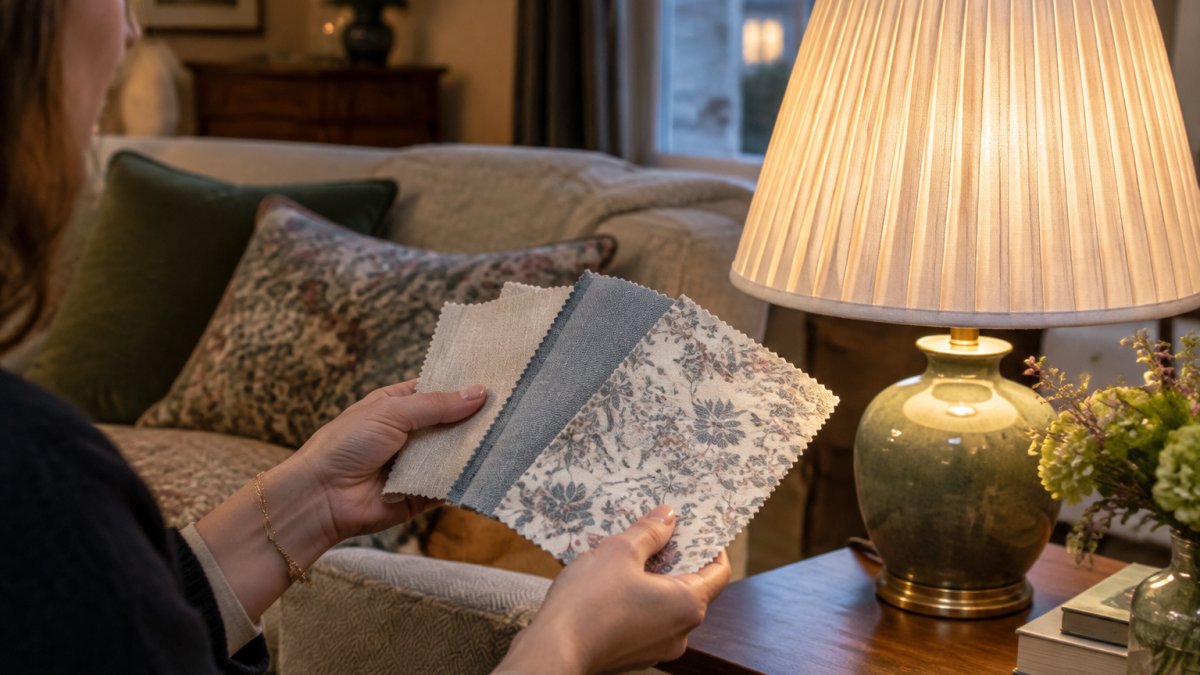
The woman is British.
Practical rules we would give any customer:
Our fabric and textiles collection lets you weigh actual materials for colour and texture before you decide, which is far more reliable than choosing from a screen.
A lining is the quiet decision that changes everything. An unlined shade glows through the fabric and casts pattern onto the wall; a lined shade directs light up and down and keeps the fabric's colour true. For a calm, cohesive room, a white or cream lining is usually the right call. For a dramatic, moody scheme, an unlined shade in a rich fabric earns its place. Whether a lining softens the glow or lets a rich fabric set the mood, that choice should sit comfortably within the wider palette and materials when designing cohesive rooms.
Coordinating home textiles and lighting means treating the shade as part of the soft furnishings, not as an afterthought. Pick up one colour from a cushion, curtain or throw and repeat it in the shade, and the room instantly reads as designed rather than decorated. Repeat a texture instead, such as pleating against a plain linen cushion, and you get the same effect with more subtlety.
A simple approach that works:
A common mistake is matching the shade exactly to the wall. It disappears. A shade that is one shade lighter or deeper than the wall keeps the room layered.
Quality in a lampshade shows in three places: the seam, the trim and the fit of the fabric to the frame. A well-made shade has a straight, tidy seam, a trim that sits flat without glue showing, and fabric pulled evenly across the frame with no ripples. Ask how the shade is made and where the fabric comes from. A maker who is proud of the provenance will tell you without hesitation.
Because you often cannot see a bespoke shade in person before ordering, treat the purchase as a remote assessment and work through it in a fixed order. A short, structured checklist can help avoid disappointment after buying home decor online.
Watch out: a maker who cannot give a clear description of the frame is asking you to buy blind.
On provenance and authenticity, ask direct questions rather than relying on badges. Ask the maker where the shade is made and where the fabric comes from. Keep the written specification for your reference if the finished shade differs from what was described.
Our made-to-order drum and oval shades start at £30.00, made in any of our fabrics. A pleated shade in Raspberry, Teal or Natural is £60.00, and a hand block-printed cotton shade in a 40cm size is £75.00.
Compare that with replacing a lamp because the shade never looked right, and the value is easy to see.
| Option | Price | Best for |
|---|---|---|
| Made-to-order drum or oval shade | From £30.00 | Any lamp, any of our fabrics |
| Pleated shade | £60.00 | Adding colour and texture |
| Hand block-printed cotton shade, 40cm | £75.00 | A statement, patterned finish |
Made-to-order shades normally take no more than two weeks, though busy periods can take longer. If you need a shade by a specific date, tell us before ordering and we will advise honestly rather than promise a date we cannot keep.
Watch out: ordering a bespoke shade in a hurry without checking the lead time is the most common way customers end up disappointed. Ask first, order second.
On returns, check the policy before you commit. If something is not right, contact us early.
Most buying guides stop there, but the practical detail matters more with a made-to-order item than with anything else you buy for a room. Work through these points before you pay:
Return window. Ask specifically whether your made-to-order shade is covered by a return window, and get the answer in writing.
Warranty. Ask what guarantee covers the frame, the fabric and the making.
A simple total-cost comparison helps here. The listed price is only part of what you pay: add delivery, any return carriage if the shade is not right, and the cost of your time if a replacement is needed.
Ordering with confidence comes down to two habits: confirm the lead time before you commit, and keep your written specification.
Choosing bespoke lampshades for a cohesive interior is really a case of making a few careful decisions in the right order: measure the base, choose the shape, then let the fabric and lining do the work. Get those right and the room pulls together.
That is exactly what our bespoke lampshade service is for. Tell us your fabric choice, your size and your lamp, and we will make a shade to fit. We offer personal shopping advice, access to our exclusive fabrics, and one-off pieces made to order, all from our independent shop. Get started with Aurina and finish the room with a shade that was made for it.

Measure the height of your lamp base from the bottom to the fitting, then aim for a shade roughly two-thirds of that height. The shade's width should be wider than the widest part of the base so it doesn't look top-heavy. Check the fitting type too, since most table lamps take a standard fitting. Aurina's handmade shades are available in drum or oval sizes, and other dimensions can be discussed by email before ordering.
Cotton is a common choice for lampshades, and a patterned cotton can add character to a plain room. A patterned cotton, such as a hand block printed stripe, adds character to a plain room. For fabric selection, order a swatch first and hold it against the wall and furniture in your own light, since a shade looks different in daylight than it does switched on.
Coordinate rather than match exactly. Repeating the same shade in every corner can look flat, while a shared fabric family, colour thread or trim ties the room together without duplication. In an open-plan space, pick one lead shade for the main seating area, then echo its colour in smaller shades on side tables or a hallway console. Coordinating home textiles and lighting this way keeps the scheme layered rather than showroom-matched.
Aurina's bespoke shades start at £30 for a handmade drum or oval in your chosen fabric, with pleated and hand block printed styles at £60 to £75. Made-to-order pieces normally take up to two weeks. Ask where the fabric is woven and who makes the shade before you buy, and check the returns policy for made-to-order items.
Comments will be approved before showing up.
