
Your Basket is Empty
Email shop@aurina.co.uk for bespoke advice

Last Updated: 1 November 2026
Quick Summary
In the linen vs velvet cushions choice, linen suits busy family sofas, warm rooms and casual schemes, while cotton velvet suits quieter sitting rooms and winter comfort. Linen is breathable and washable but creases readily; velvet is plush and deep in colour but its pile can flatten with handling. Most homes work best with both.
In the linen vs velvet cushions debate, linen brings breathable, relaxed texture to a sofa; velvet brings depth, warmth and a plush finish. Choosing between them comes down to how the room is used, who shares it, and how much upkeep you will accept. At Aurina, we sell both, and the question we hear most is which suits a particular home.
Linen and linen-blend cushions are the practical pick for busy family sofas, warm rooms and anyone who likes a natural, slightly rumpled look. Cotton velvet cushions win on tactile richness, colour depth and winter comfort. Neither is a compromise; they solve different problems.
| Question | Linen and linen-blend cushions | Cotton velvet cushions |
|---|---|---|
| Feel | Cool, dry, lightly textured | Soft, dense, plush |
| Look | Relaxed, matte, natural | Rich, light-catching, deep in colour |
| Best season | Spring and summer | Autumn and winter |
| Creasing | Creases readily, part of the charm | Holds shape, pile can flatten |
| Everyday toughness | Good, improves with washing | Good, but pile marks with handling |
| Cleaning | Covers usually washable | Spot clean and gentle care |
| Best for | Family rooms, warm rooms, casual schemes | Grown-up sitting rooms, layered styling |
| Price guide | From £37.95 | From £55.00 |
Those natural fibres are why linen-look fabric reads as casual rather than formal. Velvet is a pile fabric: a dense, short tuft sits above the base cloth, and that pile is what catches light and creates the soft, deep finish people associate with the word luxurious.
Our Axel oblong linen cushion is crafted from a cotton and linen blend, with embroidered motifs and piping and tassels on the edges.

Our Indian velvet taupe cushion is crafted from cotton velvet with a cotton piped trim, and comes filled with a luxury feather pad as standard.

Many of our cushions arrive with a feather inner as standard.
Both fabrics last well when treated sensibly, but they fail in different ways. Linen shows creasing and softens with washing, normal wear, not damage. Velvet's weak point is the pile, which can flatten in high-contact spots and mark where hands and heads rest.
When you compare cushions online, three specifications do most of the work:
For a fuller method of judging cloth before you buy, see our guide to how to assess fabric quality online. It covers what to look for in photographs, composition details and care labels when you cannot feel the fabric first.
A well-made linen-blend cover washed gently and line-dried will generally outlast a deep-pile velvet cover in the same high-contact spot, simply because linen has no pile to crush. But a velvet cushion on a quieter sofa, brushed regularly, can look good for years. The variable is handling, not fibre.
The best cushion fabric for sofas depends on who uses the sofa, and most homes need a mix rather than a single winner. If you are weighing up why choose handmade textiles over mass-produced ones, that case is worth reading alongside these trade-offs. Below we set out the trade-offs by household type.
The trade-off: linen creases fast in a house with small children. If you dislike the rumpled look, choose a linen-cotton blend rather than pure linen. Velvet is not disqualified, a dark, tightly woven cotton velvet in a low-traffic corner can survive children, but it shows hand marks and pet hair more readily.
Pet hair is the deciding factor. A soft brush attachment on a vacuum lifts hair from linen reasonably well; from velvet it takes longer and needs a rubber brush or a slightly damp glove. If the sofa is the pet's favourite spot, favour linen for the seat cushions and reserve velvet for the back cushions the animal ignores.
In a busy living room, choose linen for the seats people actually use and reserve velvet for the cushions that are mostly looked at. In an occasional sitting room, velvet earns its place: less handling means less pile flattening, and the depth of colour carries a quieter room.
A common pattern is to split the difference: linen at the back corners where heads rest, velvet in front where it is seen but not sat on. That gives you the matte-versus-sheen contrast that makes a sofa look considered, without exposing the velvet to the wear it handles least well.
Guest use is short and intense rather than constant. Velvet copes well with occasional entertaining because the pile recovers between uses, provided you brush it back upright afterwards. Linen copes well with the washing that follows a weekend of visitors. If your sofa doubles as a guest bed, favour removable, washable linen covers and keep velvet for decorative cushions only.
Linen is breathable and cool, so it suits warm, south-facing rooms and spring and summer. Velvet traps a little more warmth, making it the better choice for autumn and winter evenings and chilly rooms. A sofa used year-round often benefits from both.
If craftsmanship matters to your choice,
Cleaning velvet is about restraint. Vacuum gently with a soft brush attachment, spot clean spills immediately with a barely damp cloth, and blot rather than rub. Never scrub the pile, and never soak a velvet cover unless its care label explicitly allows it.
Steam helps revive flattened pile. Hold a steamer a short distance from the surface and brush the pile back upright with a soft clothes brush. For deeper cleaning, follow the care instructions, and remove covers only if the label says they are removable.
Watch out: pressing a damp velvet cushion while it is still wet will set the pile flat and leave a permanent mark, so let it dry fully in the shape you want it to keep.
Linen covers are usually the easier of the two to wash, but hot water and tumble drying are where they go wrong. Use a cool or lukewarm wash on a gentle cycle, a mild detergent, and skip the fabric softener, which coats the fibres and reduces their natural texture.
Remove covers only where the care label allows, and check first: some of our hand-block-printed cushions, such as the Simple Stripe cushion, specify hand washing in cool water only. Line dry or dry flat, reshape while damp, and accept some creasing, linen is meant to look lived-in.

The rule we use is simple: let one fabric lead and the other support it. A linen sofa takes velvet cushions beautifully; a velvet sofa needs the matte contrast of linen to avoid looking heavy.
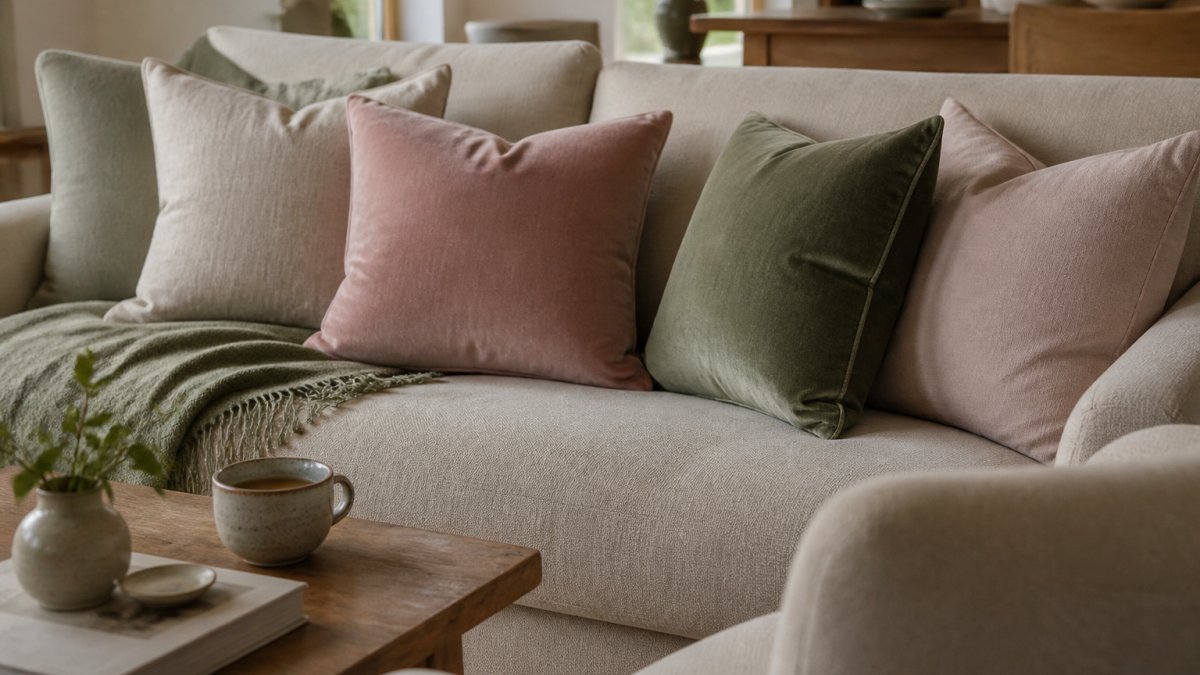
Build a colour palette of three tones and repeat them across both fabrics. Then vary size and shape: a 30 x 70cm oblong in front of a 50 x 50cm square stops the arrangement looking like a row of identical scatter cushions. For smaller rooms, our advice on styling artisanal textiles in small living rooms covers layering without crowding.
A practical starting point: two linen cushions at the back corners, one velvet cushion centred in front of each, and a textured throw over one arm. Restyle the combination each season rather than buying new.
Choosing cushion fabric is really a question about how you live in a room, not about which cloth is finer. If your sofa hosts children, pets and daily life, start with washable linen blends and add velvet where it will not be handled. If your sitting room is quieter, velvet will reward you every evening.
At Aurina, we can help you work through that choice rather than guess at it. Our independent boutique offers personalised shopping advice, access to custom fabrics and cushions, and one-off interior pieces made to order. Get started with Aurina and build a sofa arrangement that suits the way your home actually works.
Neither wins outright; it depends on the room and how you use it. Linen cushions suit everyday family sofas because the weave is breathable, hard-wearing and forgiving of creasing. Velvet cushions suit lower-traffic living rooms where you want depth of colour and a plush finish. A practical approach is to use linen for the cushions that get leaned on daily and velvet for accent pieces that are mostly decorative.
Cotton velvet is easier to care for than its reputation suggests. Blot spills straight away with a clean cloth rather than rubbing, which can crush the nap. Check the care label before using water or cleaning products.
Linen generally shows a relaxed, lived-in look with use, and a linen-cotton blend is a common choice for a smoother appearance. Check the care label for ironing guidance.
Whichever fabric you choose, check the care label and whether the cover is removable before buying, if you have pets.
Always check the care label before using water or cleaning products on velvet cushion covers.
Comments will be approved before showing up.
