
Your Basket is Empty
Email shop@aurina.co.uk for bespoke advice

Last Updated: 12 October 2026
Walk through any large homeware chain and you will see the same cushion, the same throw, the same print, repeated across hundreds of stores. That uniformity is the point of mass production. It is also the reason so many homes end up looking identical. At Aurina, we believe the case for handmade textiles over mass-produced comes down to four things: individuality, material quality, longevity, and the story behind the making.
Handmade textiles are fabrics and soft furnishings produced by skilled makers working by hand, often in small batches, rather than on automated production lines. The result is a piece with small variations from the next one, and that variation is a feature, not a fault.
If you are weighing up why choose handmade textiles over mass-produced for your own home, the answer rarely comes down to price alone. It comes down to what you want your space to say. Below, we break down the honest trade-offs, so you can decide with your eyes open.
The clearest way to see the difference is to put the two side by side. Neither option is automatically better, and the right choice depends on how you use the piece and how long you expect it to last.
| Factor | Handmade Textiles | Mass-Produced Textiles |
|---|---|---|
| Consistency | Slight variations between pieces | Identical across every unit |
| Materials | Often natural fibres, chosen by the maker | Often blended for cost efficiency |
| Production scale | Small batches, limited runs | Large volumes, continuous supply |
| Replacement | Hard to replace an exact match | Easy to buy the same item again |
| Character | Individual, one-off feel | Uniform, predictable look |
That table is not a scorecard. It is a map of the trade-offs, and the next two sections explain where each side genuinely wins.
Mass production wins on price, availability, and convenience. If you need six matching cushions by Friday, or a cheap throw for a rental flat, a mass-produced option will do the job with far less effort. There is no shame in that.
Where it falls short is character and longevity. A common mistake is assuming that a low price is always good value. A cushion that flattens within a season, or a print that fades after a few washes, costs you again when you replace it. Handmade pieces are usually made to be kept, not cycled through.
The true cost of a cheap textile rarely shows up on the price tag. It shows up later: in the second purchase, the third, and the growing pile of items that never quite worked.
Many buyers find that a well-made piece, cared for properly, simply lasts longer than its budget equivalent. The upfront price is higher. The cost per year of use is often lower. If you want a simple way to judge this, divide the price by the number of years you expect to keep it, then compare that figure across your options. A £60 cushion kept for ten years costs £6 a year. A £15 cushion replaced every eighteen months costs £10 a year. The cheaper item is the more expensive one.
Handmade home textiles bring three things a production line cannot: texture, individuality, and a sense of calm. A hand block-printed cushion, for example, carries the tiny irregularities of the printing process. Those small imperfections are what make each piece feel alive rather than manufactured.
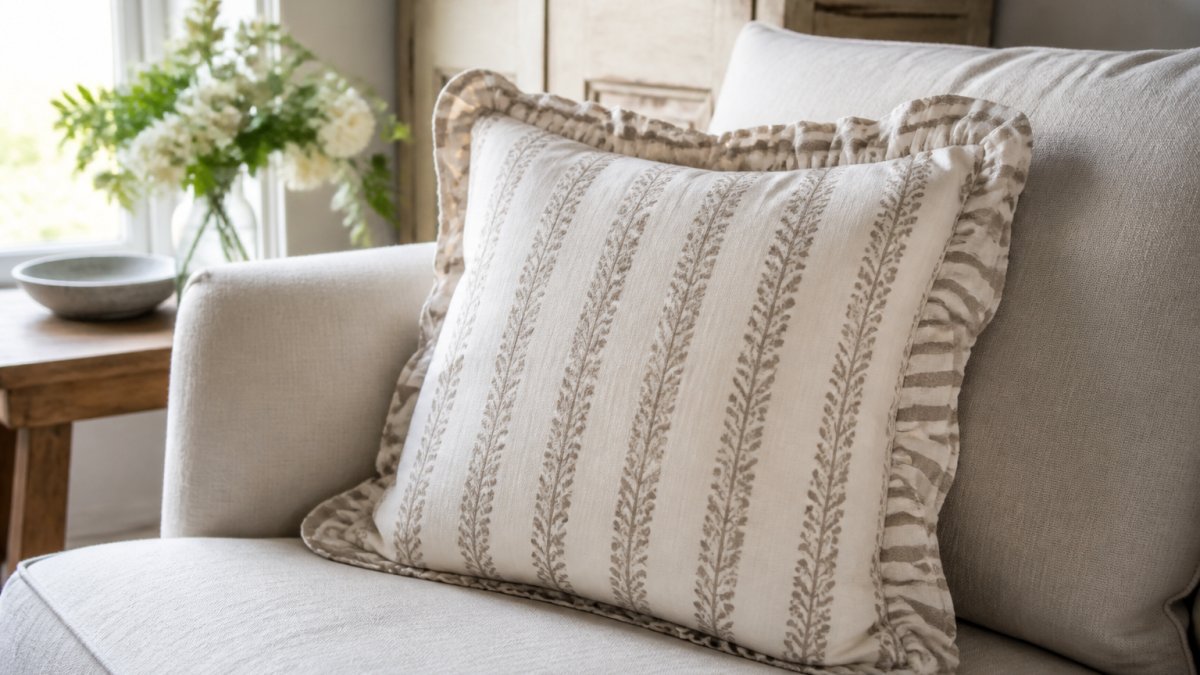
Our Simple Stripe Block Printed Cushion in Taupe is a good example. It is hand block printed by skilled makers, so every piece is unique, and it comes with a luxury feather pad that holds its shape. The 100% cotton cover is soft and breathable, and the gentle ruffle edge adds warmth without shouting for attention. It suits contemporary, Scandinavian, and hygge-inspired rooms alike.

You can spot genuine handmade textiles by looking for small irregularities, checking the reverse of the fabric, and asking the seller directly about how and where the piece was made. Machine-printed fabric is usually flawless and perfectly repeated. Hand-printed fabric is not.
Jaipur Pink Cotton Block Print Scarf →
Here is a practical checklist to run through before you commit:
Sustainable home textiles are pieces produced in a way that reduces waste, supports skilled makers, and keeps production closer to home. Handmade production fits that description more naturally than mass production, because small batches mean less unsold stock and less waste.
Small-batch making also tends to keep money within local economies. When you buy from a maker who produces in the UK, you are supporting that craft directly rather than a distant supply chain. That is the practical difference between a sustainability claim on a label and a supply chain you can actually trace. The UK government guidance on sustainable consumption and production sets out the wider policy context for buying more responsibly.
For buyers who care about where things come from, the question to ask is simple: can the seller tell you who made this, and where? If the answer is vague, the ethics claim probably is too.
Before you choose handmade, weigh four practical factors: budget, care requirements, matching, and lead time. Handmade pieces usually cost more upfront, need gentler washing, and are harder to match if you want several identical items. None of these are dealbreakers, but they are worth knowing in advance.
Our cotton block print scarves, for instance, are 100% hand block printed cotton, sized 110 x 180 cm, and each one is genuinely unique. No two are identical, and small imperfections are part of the nature of block printing. If you want a set, order it in one go.

If you are unsure how a piece will sit in your own room, ask us. We offer personalised shopping advice and can talk you through colours, scale, and how a fabric behaves in natural light before you commit. The UK consumer rights guidance on shopping online explains your protections when you buy remotely, which is useful to know before ordering textiles you have not seen in person.
Handmade textiles are crafted individually by skilled makers, so each piece carries small variations that reflect the human hand. Mass-produced textiles are made on automated lines to an identical standard, which means thousands of units look exactly the same. The practical difference shows in details: hand block-printed cotton, for example, will have slight imperfections in the pattern because each impression is placed by hand. Those variations are not faults; they are the signature of the making process.
Often, yes, but it depends on the maker. Handmade pieces typically use materials chosen for how they feel and wear rather than for how cheaply they can be sourced. A hand block-printed cotton cushion with a feather pad, for instance, is built to be used daily and keep its shape. Mass-produced textiles can be perfectly serviceable, but corners are usually cut on fabric weight, stitching and finishing to hit a lower price point. Check the material and construction, not just the label.
The price reflects time and skill. A maker might spend hours on a single piece, and no two are identical, so there are no economies of scale. Materials also cost more when sourced in smaller quantities. That is why a hand block-printed cushion can cost £59.95 while a high street equivalent might be a fraction of that. You are paying for the craft, the materials and the fact that your piece will not look like everyone else's.
Look for small irregularities in the pattern, slight variations in colour or print alignment, and a maker's name or story attached to the product. Genuine handmade textiles rarely have perfectly uniform repeats. Ask where and how the piece was made. A transparent maker will tell you the technique, the materials and the workshop. If the seller cannot answer those questions, treat the handmade claim with caution. Texture and weight are also clues: hand-printed cotton feels different from a digitally printed synthetic blend.
Choosing textiles for a home is rarely about one perfect purchase. It is about building a space that feels like yours, piece by piece, over time. Aurina can help you get there, with British design-led home textiles, bespoke interior design services, and custom fabrics and cushions made to order. Our team offers personalised advice whether you visit the boutique or order from further afield. Subscribe to hear first when new handmade pieces arrive.
Comments will be approved before showing up.