
Your Basket is Empty
Email shop@aurina.co.uk for bespoke advice

Last Updated: 5 November 2026
Quick Summary
To choose British-made cotton tea towels, check the sewn-in care label for 100% cotton and a made in Britain claim, then confirm where the cloth was woven and where the towel was cut and sewn. A tight flat weave is effectively lint-free on glassware, while terry towelling holds more water for pans and spills.
A good kitchen cloth is judged by what it leaves behind. If it smears a glass rather than drying it, the fabric is wrong. The questions people ask most often are about how to choose British-made cotton tea towels that actually dry rather than simply move water around. That matters, because a tea towel is one of the few kitchen items you touch every single day. Below, we break down the fabric, the weave, the origin checks and the care that keeps a good towel good.
Cotton is a natural fibre that absorbs water well. A thin, loosely woven cloth has less fibre to hold water, which is why lighter towels tend to be less absorbent.
Three things decide whether a tea towel earns its place on your rail:
A towel labelled 100% cotton contains no polyester or viscose blend. That matters for absorbency. Blended textiles often feel smooth but push water around instead of soaking it up.
Look for the words on the care label, not just the swing tag. A towel described as "cotton-rich" may still contain a synthetic share. If the label says 100% cotton, you know what you are buying.
Flat weave produces a smooth, thin cloth with a tight grid of threads. Terry towelling has loops that hold more water.
Fabric weight tells you how substantial the cloth feels. A lightweight flat weave is fast to dry but holds less water. A mid-weight cotton hits the balance most kitchens want.
Cotton holds more water than linen, which is why it suits everyday dishes. Linen dries faster but can feel stiffer at first.
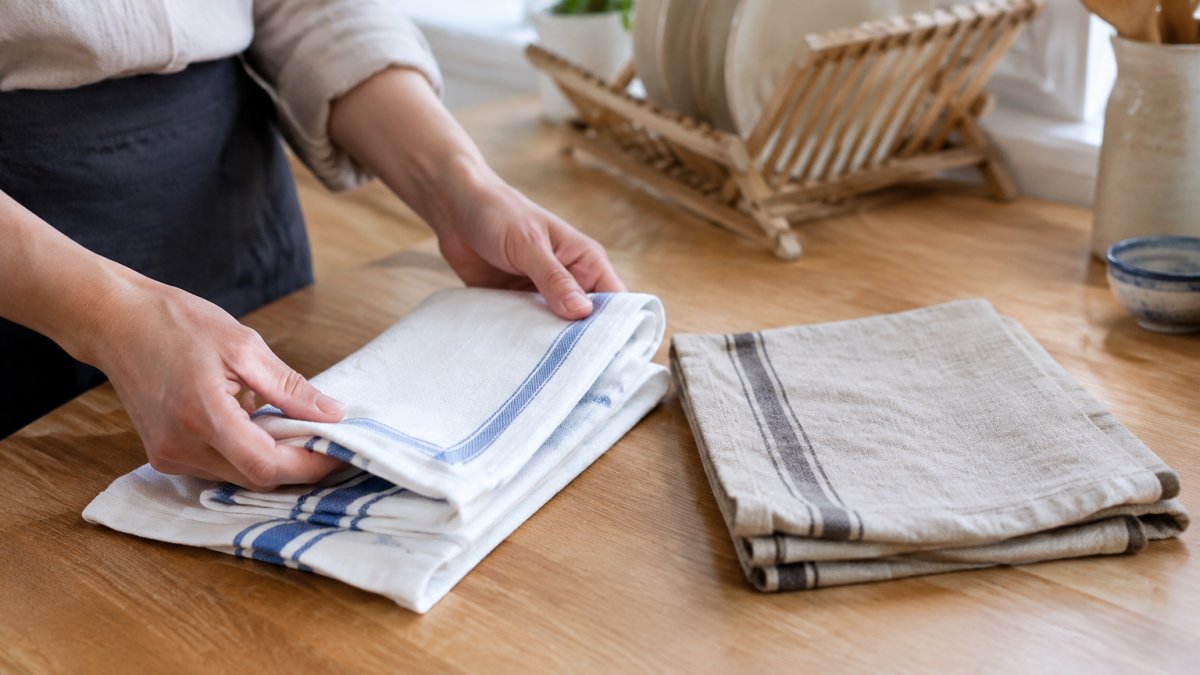
The practical differences come down to four points:
Linen has a place. It looks beautiful and many people enjoy it for the table. If you want one cloth that handles dishes, hands and spills, cotton is the more practical choice.
Cotton and linen each have their strengths, so here is how they compare on the points that matter most.
| Feature | Cotton | Linen |
|---|---|---|
| Absorbency | Holds a good amount of water | Holds less water than cotton |
| Drying speed | Slower than linen | Edges ahead, releases moisture faster |
| Feel | Soft from the first wash | Can feel stiffer at first, needs breaking in |
| Lint | Tight flat weave is effectively lint-free on glassware | Not stated |
Authenticity is where the market gets murky. "Designed in Britain" is not the same as "made in Britain". The first describes where the idea started; the second describes where the cloth was woven, cut and sewn.
Under UK consumer protection guidance on misleading descriptions, a business must not describe goods in a way that misleads about where they were made. That gives you real ground to ask questions, but it does not create a single official "British-made" logo you can look for. Instead, you have to read the claim and test it against the detail.
A defensible manufacturing claim should tell you where the substantial transformation happened. For a tea towel, that means the weaving of the cloth and the cutting and sewing of the finished article. A towel can legitimately be called British-made if the fabric was woven here and the hemming and finishing took place here. It is weaker if the cloth was imported and only the printing or packing happened in the UK.
Ask three questions before you buy:
Look for the phrase "made in Britain" or "made in the UK" printed on the sewn-in care label itself, not only in marketing copy. The label is the declaration; the swing tag and the hero image are marketing. Then check the maker's website for a named mill, a workshop address or a small-batch note. These all point to real manufacturing rather than a licensed design printed onto imported blanks.
Watch out: a Union flag on the packaging proves nothing on its own. Flags are decorative; labels are declarations. The same applies to phrases like "British design" or "UK brand", which describe the business, not the cloth.
Three common arrangements get confused:
If the page does not make clear which of these applies, email the retailer and ask where the cloth was woven and where the towel was cut and sewn. A maker with nothing to hide will answer specifically. A retailer working from a drop-ship catalogue will usually reply with the design story instead.
Different tasks reward different cloths. Buying one type for everything is how drawers fill with towels that never quite work.
A hanging loop sounds trivial until you use a towel without one. It keeps the cloth off the counter and speeds drying between uses.
Wash at 30 to 40 degrees with similar colours. Skip fabric softener, because it coats the fibres and blocks absorbency. Line drying keeps the weave tight and the colours true.
Watch out: tumble drying on high heat is the fastest way to shrink and distort a cotton towel. Use a low setting or line dry.
Check these details before you commit:
Choosing well comes down to a handful of checks: confirm the fibre, feel the weave, verify the origin and match the cloth to the task. Do that and a cotton tea towel becomes one of the best-value kitchen essentials you own.
You can put that advice to work straight away. Browse our kitchen linens to see the full range, or start with a specific design: the Cotton Jemima Duck Tea Towel and the Cotton Hetty Hare Tea Towel are both 100% cotton at £8.99, with a hanging loop and a print that softens with every wash. If you prefer a slightly larger cloth, the Cotton Duck Tea Towel Nellie measures 79cm x 47cm and suits heavy daily use.

Look for a clear 'Made in Britain' or 'Made in UK' statement on the sewn-in label, not just the website copy. Check whether the brand names its mill, workshop or manufacturer, and whether the product page lists fabric weight, dimensions and fibre content. Be wary of vague phrases such as 'British design' with no manufacturing claim, and ask directly if the origin is unclear.
Linen dries quickly between uses. Cotton holds more water and feels softer against the hand. Blends aim to combine both. For most kitchens, a mid-weight cotton tea towel is the more forgiving everyday choice, while linen earns its place for polishing and lint-free finishing.
GSM (grams per square metre) tells you how dense the cloth is. Ask the retailer for the GSM figure if it is not listed, as it describes how dense the cloth is.
Wash new cotton tea towels before first use to remove any sizing and to settle the fibres. Use a warm wash, avoid overloading the machine and skip fabric softener, which coats the fibres and reduces absorbency. Line dry where possible and reshape while damp. Wash dark prints separately for the first few cycles. Rotating several towels rather than relying on one spreads the wear and keeps the cloth fresher between washes.
The difference between a towel that frustrates you and one you reach for daily is rarely the price. It is the fibre, the weave and the honesty of the label. At Aurina, we curate British design-led home textiles with exactly that in mind, and we are always happy to talk through fabric, colour or a custom piece before you commit. Subscribe to hear about new arrivals and one-off designs made to order.
Comments will be approved before showing up.
