
Your Basket is Empty
Email shop@aurina.co.uk for bespoke advice

Last Updated: 3 November 2026
Quick Summary
Handmade cotton tablecloths are worth it for dining rooms because they can be cut to your table's exact dimensions, giving an even drop on all four sides, and the natural cotton drapes well and softens with every wash. Check the GSM and pre-washing before you buy.
The case for handmade is not nostalgia. It is fit, weight and longevity. A cloth can be cut to your table's exact dimensions, so the drop is even on all four sides and the corners hang cleanly.
Below, we break down what to look for in fabric weight and weave, how to measure for a tablecloth without guesswork, and how to care for handmade cotton so it lasts for years rather than months.
The benefits of handmade textiles come down to three things: better cloth, better finishing and a shorter supply chain. Mass-market table linen is usually cut from the widest, cheapest roll available and sewn to a handful of standard sizes, so the cloth you receive was designed for an average table that does not exist in your house.
Natural cotton fibres breathe, so a warm dish does not trap condensation under the cloth the way a synthetic blend can.
There is a sustainability argument too. Choosing fewer pieces, made better and replaced less often, is a practical way to reduce waste.
Watch out: the word "handmade" is not regulated on a product label, so ask what specifically is done by hand, whether that is the weaving, the hemming or the finishing.
Fabric weight decides how a tablecloth behaves, and it is the single most useful specification to check before you buy.
For everyday dining, look for a mid-weight cotton with enough body to hang in a clean line without being board-stiff.
Drape is the visible result of weight plus weave plus how the cloth is cut. A well-draped cloth falls straight from the table edge with soft folds at the corners rather than flaring out.
GSM stands for grams per square metre, and it is the standard way to express fabric weight: a 200 GSM cotton weighs 200 grams for every square metre of cloth.
Ask for the GSM before you commit. It tells you more about how a tablecloth will hang and wear than any photograph can.
Fabric weight is the single most useful specification to check, so here is how the GSM bands compare.
| GSM band | Best for | Key difference |
|---|---|---|
| Under roughly 150 GSM | Crisp, summery feel | Creases easily |
| Around 150 to 250 GSM | Year-round dining | Mid-weight with enough body |
| Above roughly 250 GSM | Substantial, formal settings | Needs more room in the wash |
To measure for a tablecloth, measure your table's length and width, then add twice your chosen drop to each measurement. The drop is how far the cloth hangs below the table edge, and it is the number most people get wrong.
Work through it in this order:
For a round table, measure the diameter and add twice the drop. For an oval, measure the longest and shortest points across the top.
Shape matters as much as size. A rectangular cloth on a rectangular table gives you even corners and a clean line. A square cloth on a round table works if the drop is short, because the corners then fall as points rather than pooling on the floor.
If your table is an unusual size, this is exactly where custom dimensions pay off. A bespoke cloth cut to your measurements can remove that compromise.
Wide Stripe Medium Tablecloth Sage & Stone →
Caring for handmade cotton fabrics is straightforward, and the rules are mostly about heat, haste and knowing which stain you are dealing with. Wash at 30°C to 40°C on a gentle cycle with a mild, non-biological detergent, and avoid overloading the drum so the cloth can move freely. Skip the tumble dryer where you can: line drying in shade keeps the colour and the fibre in better condition and avoids heat shrinkage.
A few habits extend life considerably:
Treat stains promptly and by type. Blot rather than rub, work from the outside of the mark inwards, and rinse with cool water before applying anything.
Watch out: chlorine bleach will weaken cotton fibres and dull dyed colour over time. If you need to lift a stubborn mark, use an oxygen-based stain remover instead, and test it on an inconspicuous corner first.
A handmade cotton cloth rarely fails in the middle. The first things to go are the hem, the corners and any area that sits under a hot dish. Check the hem after every few washes and re-stitch any loose thread before it becomes a frayed edge. Use a trivet under hot serving dishes rather than relying on the cloth to protect the table.
Shabby chic and cottage style work because they look collected rather than bought in one go, and the table is the easiest place to get that effect.
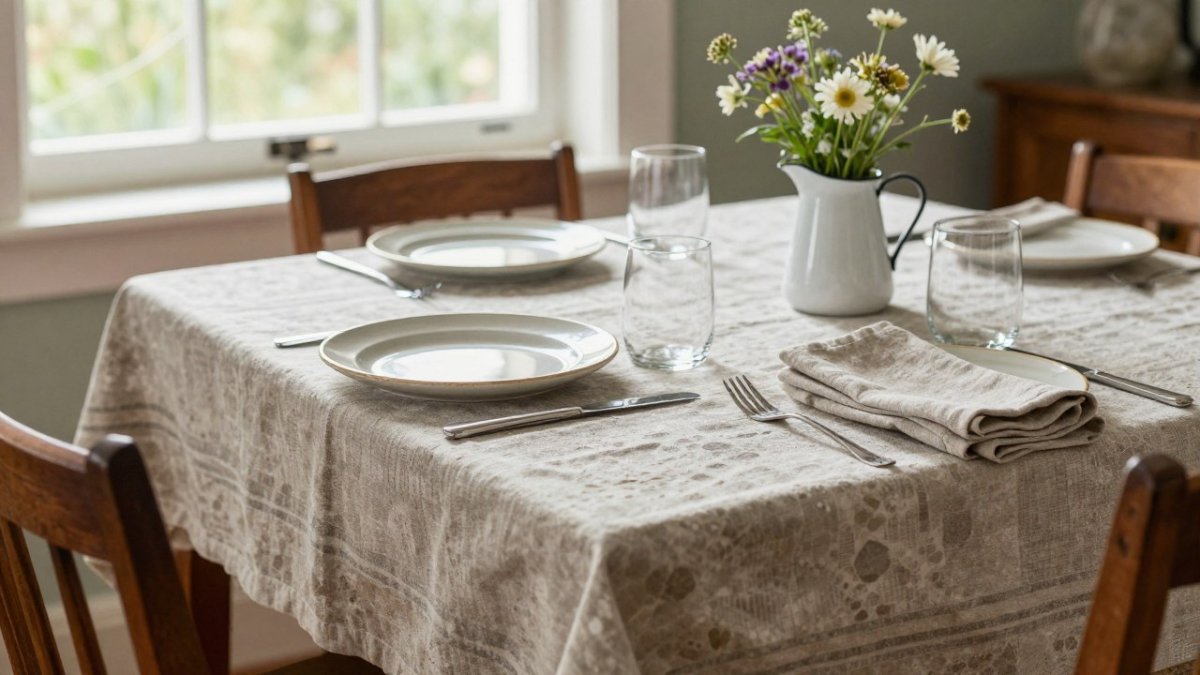
Layer from the bottom up. Cloth first, then a table runner down the centre if you want extra texture, then napkins in a contrasting but related tone.
The rule we would give anyone building this look: buy fewer things, but buy the ones you actually love. If you want to finish the layered, cottage-style tablescape this section describes, linen napkins to complete the setting are the natural next piece.
A seasonal rotation is the practical half of the cottage look, and it costs nothing beyond a second cloth. The idea is simple: keep two or three cloths and swap them through the year so the table changes with the light and the garden, and so no single cloth takes all the wear.
Rotate on a practical schedule rather than a strict calendar: swap when the cloth comes back from the wash, and store the out-of-season cloth folded in a dry cupboard away from direct sun.
Aurina offers bespoke interior design and custom product services, and custom dimensions can suit tables that standard sizing does not cover.
Choosing well comes down to four checks: the fibre and its weight, the finished size against your measured drop, the finishing on the hem, and whether the colour will work in your actual room.
As an independent boutique, we are dedicated to designing and manufacturing in the UK and offer bespoke interior design and custom product services. Our dining room range shows the tablecloths alongside the coordinating pieces, which is the easiest way to see how a colour will sit in context. If you want a soft shade for a cottage interior, the pastel pink Manni cotton table cloth is the gentlest option, the pale blue Manni cotton table cloth reads cooler against white walls, and the sage green Manni cotton table cloth sits closest to the natural palette we have described throughout.
Our Wide Stripe Medium Tablecloth in Sage & Stone is a good example of the approach: 100% cotton, machine washable, 150 x 250 cm, and simple enough to dress up or down with a change of napkins.
Handmade cotton tablecloths use natural fibres that breathe, so they handle heat and spills better than synthetic cloths. Natural cotton can give a smooth, even drape, and the weave can hold colour through repeated washing. They also age well: a well-cared-for cotton cloth develops the softness and heirloom quality that mass-market table linen rarely reaches.
Measure your table's length and width first, then decide your table drop. A 20cm drop suits everyday dining, while 30cm or more gives a formal look for a dining occasion. Add twice the drop to each dimension. For a 150 x 250cm cloth, that fits a table around 110 x 210cm at a 20cm drop. Always check the shape matches too: rectangular cloths on rectangular tables, round on round. When in doubt, ask for custom dimensions.
Yes, when you treat them sensibly. Cotton is a strong natural fibre, and a tighter weave with a higher fabric weight can resist snagging and thinning. Wash at 30°C on a gentle cycle, avoid overloading the drum, and treat stains promptly rather than letting them set. Rotating two cloths between washes spreads the wear. Avoid bleach on coloured pieces to protect colourfast dyes. Looked after this way, a handmade cotton tablecloth should serve daily meals for years.
Wash at 30°C on a gentle cycle with a mild detergent, and skip fabric softener, which coats the breathable fibres. Treat food stains by blotting, not rubbing, then soak briefly in cool water before washing. Line dry or tumble on low, and press while slightly damp for a crisp finish. Store folded in a dry cupboard away from direct sunlight. Following these steps for caring for handmade cotton fabrics keeps the weave, colour and drape intact for far longer.
The real test of a tablecloth is not how it looks on the day it arrives, but how it looks after two years of Sunday lunches. We would rather help you get the fibre, the weight and the measurements right the first time than sell you a cloth you replace next season. Get started with Aurina and dress your dining table with a handmade cotton tablecloth made to fit it properly.
Comments will be approved before showing up.
