
Your Basket is Empty
Email shop@aurina.co.uk for bespoke advice

Last Updated: October 23, 2026
Quick Summary
The best rockett st george alternatives for textiles are pieces with a stated fabric weight, an honest care label and a named country of manufacture. Look for heavier woven faces where a piece takes daily use, and match the care regime to the room before the colour.
If you have browsed Rockett St George for cushions or throws, you already know the appeal: bold pattern, rich colour, a certain theatrical confidence. The trouble is that a whole room styled from one source can start to feel like a showroom rather than a home. This guide from Aurina looks at the best Rockett St George alternatives for textiles, with an emphasis on pieces that are genuinely made here and chosen with care rather than picked from a catalogue.
We are an independent boutique, so we have a stake in this argument. Our view is simple: the strongest interiors mix one or two statement textiles with quieter, better-made basics that will survive a decade of family life. The best Rockett St George alternatives for textiles are not necessarily the loudest. They are the ones whose construction justifies the price.
Below, we break down what actually separates a good cushion from an expensive one, which British home textile brands are worth your attention, and how to shop online without the usual disappointments.
Start with the fabric itself, not the photograph. A textile is only as good as its weight, its weave and the honesty of its care label, and those three details tell you more than any styled room shot ever will.
Fabric weight is measured in grams per square metre (GSM), and it is the single most useful number on a product page. A heavier woven face holds its shape, resists pilling and drapes with some substance. Lighter backings keep a piece supple and affordable. Look for a stated GSM rather than vague words like "luxurious". A common mistake is assuming a high price guarantees a heavy cloth. It does not.
Read the care label before you fall in love with the colour. Some woven textiles are spot clean only, which suits a decorative floor cushion but not a kitchen textile that will meet hot fat and steam. Others are machine washable and will take years of use. Match the care regime to where the piece will actually live.

The most reliable signal of quality is a maker who will tell you exactly where a piece was made. British home textile brands that design and manufacture domestically tend to be smaller, more accountable operations, and their product pages usually say so plainly.
At Aurina, everything we sell is designed with British manufacturing in mind, and our own textiles are made here. That matters for more than sentiment. Short supply chains mean smaller production runs.
When you compare brands, use the same three tests every time:
If a brand cannot answer all three, treat the premium price with suspicion.
The difference between a designer cushion and a high street one usually comes down to three things: the weight of the face fabric, the quality of the filling, and whether the pattern is woven or merely printed onto a thin base cloth.
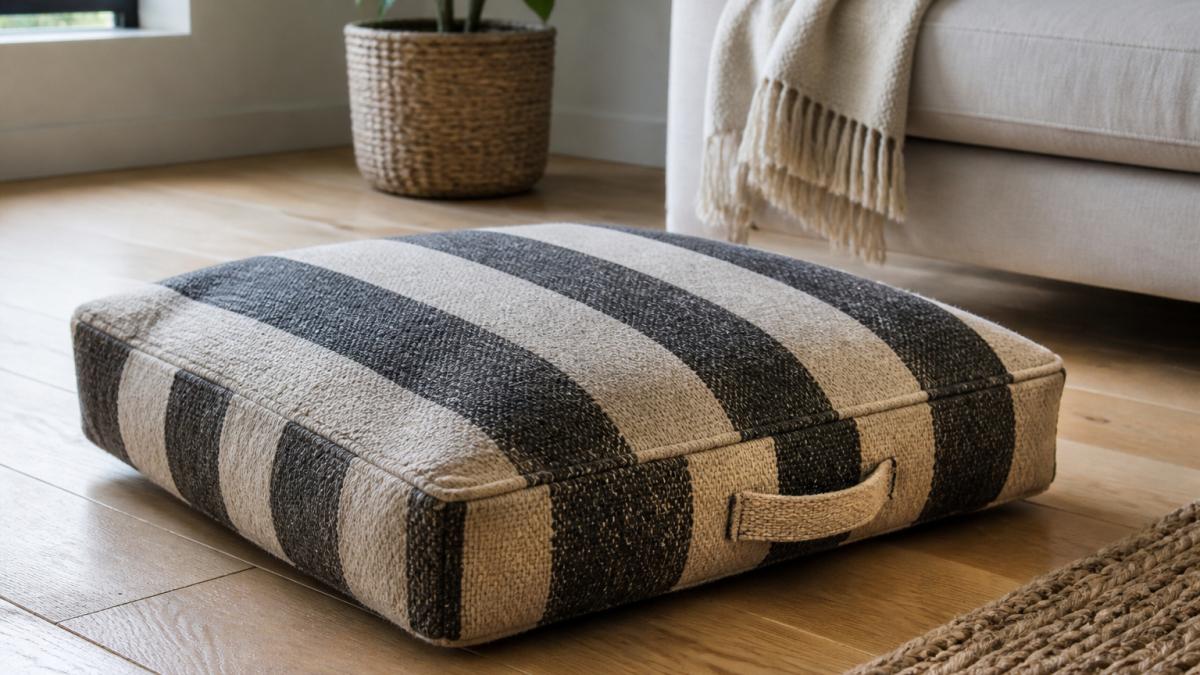
Designer cushions and throws earn their price through construction you can feel. A woven stripe has texture and depth that a print cannot replicate, and it wears better at the seams. Filling matters just as much: a generous poly fibre pad holds its loft, while a thin one collapses within months. Check the dimensions too. A 580 mm square cushion reads very differently on a two-seat sofa than on a deep corner unit.
Floor cushions are the most underrated textile purchase in the house. They solve the awkward corner, add flexible seating for guests, and can be moved from sitting room to garden room without a second thought.
Our Seaside Stripe Floor Cushion is a good example of how we think about the category. It measures 580 mm wide by 580 mm deep and 100 mm high, with a woven face at 930 GSM and a lighter 375 GSM reverse, filled with poly fibre. The carry handle makes it easy to reposition, and the pink and green stripes add colour without demanding a whole new scheme. It is spot clean only, so treat it as a decorative seat rather than a utility piece. At £64.95, it costs less than most designer throws.
Seaside Stripe Floor Cushion →
Sustainability in textiles is mostly a question of longevity. A cushion you keep for ten years is a better environmental choice than three you replace, regardless of what the hangtag claims. Sustainable home textiles are, in practice, well-made textiles.
Here is how we would judge a claim:
The GOV.UK guidance on textile labelling sets out what fibre information must legally appear on products sold here. Beyond the legal minimum, look for the details a careful maker volunteers.
Use this table to weigh the practical differences between the textile types we stock, then match the piece to the room rather than to the photograph.
| Textile | Price | Key Spec | Care | Best For |
|---|---|---|---|---|
| Seaside Stripe Floor Cushion | £64.95 | 580 x 580 x 100 mm, 930 GSM woven face | Spot clean only | Flexible extra seating, garden room corners |
| Double Oven Glove, Sage & Stone | £19.95 | 87.5 cm x 19.5 cm, extra thick | Machine washable | Daily kitchen use, Aga and range ovens |
| Double Oven Glove, Red & Stone | £19.95 | 87.5 cm x 19.5 cm, extra thick | Extremely washable | Gifting, classic kitchen schemes |
Both oven gloves are made in England and share the same wide stripe construction, so the choice between sage and red is purely a question of your kitchen palette. The Seaside Stripe Floor Cushion and the Sage & Stone oven glove sit happily in the same room if you like a coordinated stripe.

Ordering textiles without seeing them is manageable, provided you avoid the four traps that catch most people.
First, buying to a photograph rather than a specification. Second, ignoring the care label until the first spill. Third, ordering a single cushion for a large sofa, when two or three smaller pieces would look more considered. Fourth, assuming that a higher price automatically means a heavier cloth.
A common mistake is treating a floor cushion as a substitute for an armchair. It is flexible, storable seating that works best alongside proper furniture.
The best Rockett St George alternatives for textiles are the ones that suit how you actually live: a heavier woven face where the piece takes daily use, an honest care label, and a maker willing to tell you where it was made. Get those three right and the colour becomes the easy part.
If you are weighing up the best Rockett St George alternatives for textiles and want to see the cloth before you commit, we are always happy to talk through weights, dimensions and how a stripe will read in your room. Browse our Red & Stone oven glove for a sense of our signature stripe, or ask us about custom fabrics and made-to-order cushions.

Look for independent British home textile brands that prioritise design-led patterns and quality construction. Check fabric weight, care instructions, and whether the brand manufactures in the UK. A good alternative should offer statement cushions, throws, and accessories with a distinct aesthetic, plus clear information about materials and returns.
Independent boutiques and specialist British home textile brands are your best bet. Look for retailers that state where products are made and describe fabric composition in detail. Many offer bespoke services, such as custom fabrics or made-to-order cushions, which high-street shops rarely provide.
Compare fabric weight (GSM), material composition, care instructions, and country of manufacture. Heavier fabrics generally last longer and hold their shape better. Read the returns policy carefully. Sustainable home textiles should come with clear information about materials and sourcing, not just vague claims. Price per item matters, but so does how many years of use you will get from it.
Yes, several independent boutiques focus on British design and manufacturing. They often combine traditional techniques with contemporary patterns, and many offer personalised advice or bespoke services. Look for brands that are transparent about their supply chain and can tell you exactly where items are made. Visiting in person helps you judge quality before committing to a purchase.
Choosing textiles for a whole room is harder than it looks, and the stakes are higher when you are buying online without touching the cloth. Aurina can take the guesswork out of it: we offer personal shopping advice, access to custom fabrics and cushions, and one-off interior pieces made to order from our independent boutique. Get started with Aurina and build a scheme that reflects your home rather than a catalogue page.
Comments will be approved before showing up.
