
Your Basket is Empty
Email shop@aurina.co.uk for bespoke advice

Last Updated: 23 October 2026
Quick Summary
Buying locally made home accessories gives you traceable craftsmanship, better materials and money that stays in the local economy. Shorter supply chains mean less transport and less unsold stock, and you can go back to the maker for repairs. Ask who made a piece and where before you buy.
Locally made home accessories are decorative and functional pieces for the home, such as cushions, ceramics, candles and textiles, produced by makers and small workshops close to where they are sold. At Aurina, we have built our shop around them because the benefits of buying locally made home accessories run deeper than the surface finish.
The case rests on three things: traceable craftsmanship, better materials, and money that stays in the local economy. A hand block-printed cushion or a hand-painted ceramic bird carries the marks of the person who made it. Mass-market equivalents rarely do.
Below, we will show you how to tell genuine local pieces from clever marketing, what the quality difference actually looks like, and which pieces earn their place in a home.
The fastest way to identify British-made products is to ask for the paper trail: the maker's name, the workshop location, and a specific manufacturing claim rather than a vague "designed in" badge. "Designed in Britain" and "made in Britain" are not the same statement, and some retailers rely on that confusion.
Start with the label. Then go further:
We are always happy to explain where a piece comes from, because a straight answer is the whole point of shopping this way. For a fuller checklist, our guide on how to verify British made home decor walks through seven practical checks before you buy.
A country of origin label tells you where a product was last substantially changed, not where every component came from. A cushion can be sewn locally from imported fabric, and a ceramic piece can be decorated here from a blank cast elsewhere.
That does not make either piece dishonest. It means the label answers one question, and you may want to ask two or three more before deciding.
Small-batch homeware tends to differ from mass-produced pieces in ways you can feel. Hand block printing leaves slight variations in the pattern. Hand-painted ceramics carry small differences in glaze and colour. Those imperfections are evidence of a person at work, not defects.
Construction is the other tell. A cushion with a proper feather pad and a hand-finished edge sits differently on a sofa than one with a thin synthetic filling. An enamel platter on a heavy iron base resists chips in a way thin pressed metal does not.
If you want the longer argument, our piece on why handmade textiles outperform mass-produced alternatives sets out the comparison in detail. The short version: you are paying for time, skill and materials rather than volume.
Sustainable home accessories are pieces made with materials and processes that limit waste and environmental cost, and local production supports that in several concrete ways. Shorter supply chains mean less transport. Small runs mean less unsold stock going to landfill. Repair and reupholstery are easier when you can go back to the person who made the piece.
There is also a durability argument. A well-made cushion cover or a stoneware ornament is designed to be kept, not replaced each season. Buying fewer, better things is the most reliable sustainability move available to most households.
For a wider framework covering materials, packaging and ethics, see our ethical shopping guide for home decor. It is written for people who want to apply the same standard across everything they buy, not just the occasional treat.
Large Round Enamel Platter - Forest →
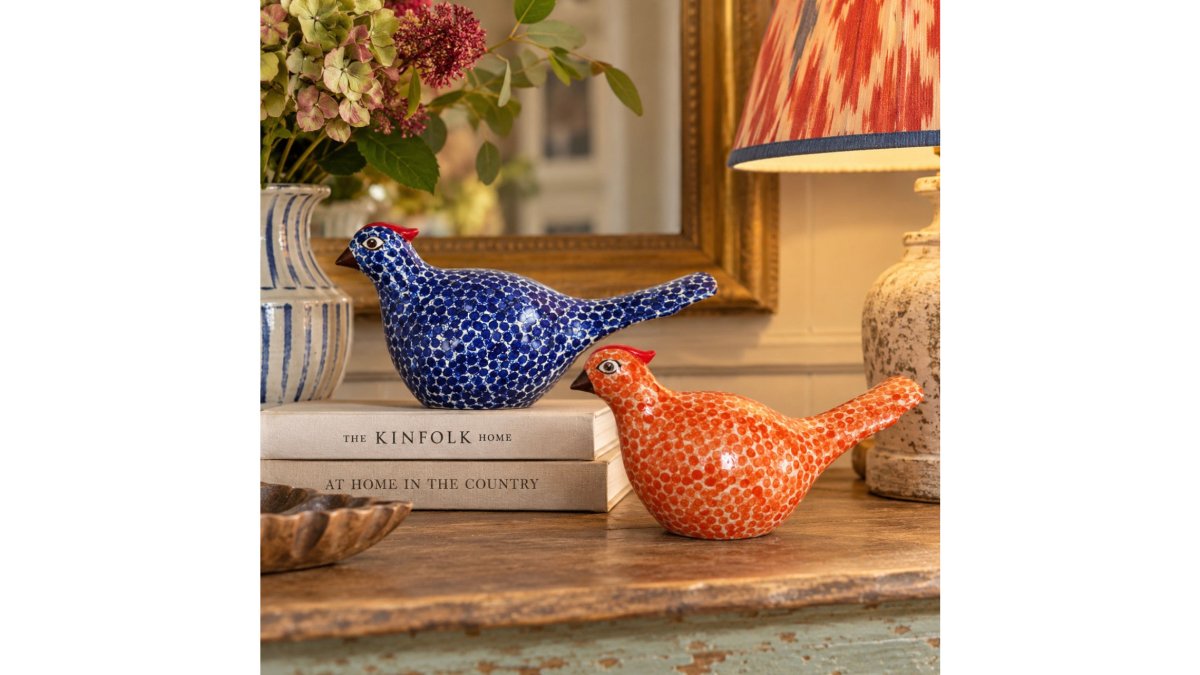
The best way to see the difference is to look at specific pieces. Take the Penelope hand painted ceramic pheasant at £88.95. Each bird is individually hand-painted in a speckled glaze, so no two are identical, and the small variations in colour and finish are part of the character rather than a flaw.

The Simple Stripe Block Printed Cushion in Taupe at £59.95 shows the same principle in textiles. Each 50cm cover is hand block printed by skilled makers, comes with a luxury feather pad, and finishes with a soft ruffle edge. Compare that with a printed cushion from a large retailer and the difference is in the weight and the detail.

Smaller pieces carry the same story. The Teal Taper Dinner Candle at £1.50 is handmade here by time-served chandlers using a drawn-wick process, with around eight hours of burn time. The Aurina Nellie Large Bone China Mug at £14.99 is hand-decorated in Stoke-on-Trent, dishwasher and microwave proof, and slightly different from every other mug in the batch.

Money spent with local makers tends to stay closer to home. It pays a workshop rent, funds the next batch of materials, and keeps a craft skill in use rather than archived. That matters most for trades that depend on steady orders to survive, from block printers to ceramic decorators.
There is a personal side too. Independent shops live on repeat customers, so service tends to be better and advice more honest. Our own customers tell us the welcome is what they remember: one wrote that it was "so nice to meet you and see the shop which made our trip out," and another said it was "a pleasure to shop and receive such a nice welcome."
If you want to find more makers to support, our roundup of the best British made interior design brands is a good place to start.
Ignore any claim that cannot survive a direct question. A flag on a label, a story about heritage, or the word "artisan" used without a named maker tells you nothing verifiable. The same goes for prices justified only by the word "boutique."
Three things are worth your attention instead:
| What to ignore | What to check instead | Why it matters |
|---|---|---|
| "Designed in" badges | Where the piece was actually made | Design and manufacture are different claims |
| Vague eco language | Named materials and processes | Sustainability needs specifics |
| Unnamed "artisan" claims | The maker or workshop name | Traceability is the whole point |
On price, the honest answer is that small-batch work costs more to produce. What you get in return is a piece made in limited numbers, often to order, with materials chosen for longevity. If a specific piece is not right for your space, ask us about returns before you order, and check dimensions and colours against your room rather than a screen.
The real challenge is not finding local pieces; it is choosing ones you will still want in five years. That means buying fewer things, asking better questions, and favouring makers who can tell you exactly how a piece was made.
At Aurina, we curate British design-led home textiles, ceramics and gifts, and we offer personal advice, custom fabrics and cushions, and one-off pieces made to order. If you are unsure what suits your space, tell us about the room and we will point you in the right direction. Subscribe to hear about new arrivals and one-off pieces before they go.
Buying locally made home accessories gives you pieces with visible craft detail, such as hand-painted finishes or block-printed patterns, that mass-produced items rarely match. You also support skilled makers and reduce the distance goods travel. Locally made home accessories often come with a story about who made them and where, which adds meaning to everyday objects. The trade-off is usually a higher price and a smaller selection, but you get uniqueness and a clearer sense of value.
Look for a specific origin claim, not a vague 'designed in' label. Genuine British-made products often name the workshop or town, such as 'hand-decorated in Stoke-on-Trent' or 'handmade in the UK'. Check the product page for material and process details: a maker who block-prints or hand-paints each piece will usually say so. If the description only says 'British design' without a manufacturing location, ask the retailer directly before buying.
Not automatically, but the making process often shows in the finish. Hand-painted ceramics, hand-drawn candles and block-printed textiles usually involve more checks per item than high-volume production. For example, a hand-painted ceramic bird has slight variations in colour and glaze that reflect individual work. Locally made homeware tends to be produced in smaller batches, so flaws are caught earlier. Ask about materials and care instructions, then judge the piece on its actual construction.
They can be, mainly because shorter supply chains mean fewer miles travelled and smaller production runs mean less waste. Sustainable home accessories from local makers often use materials like recycled paper, sustainably sourced wood or natural cotton. That said, sustainability depends on the specific maker: ask about packaging, material sourcing and how far components travel. Buying locally is one useful signal, not a guarantee, so combine it with clear product information before you decide.
Comments will be approved before showing up.
