
Your Basket is Empty
Email shop@aurina.co.uk for bespoke advice

Last Updated: 10 November 2026
Quick Summary
The best cotton fabric for upholstery projects is one matched to the piece, the room and the life lived in it, rather than simply the heaviest or most expensive option. For sofa seats and family furniture, start with heavy weights above roughly 300 gsm, and check the Martindale rub count alongside composition and colourfastness.
Cotton is the natural fibre most upholstery projects come back to, and for good reason: it breathes, it softens with age, and it takes a print beautifully. The best cotton fabric for upholstery projects is rarely the heaviest or the most expensive. It is the one matched to the piece, the room and the life lived in it.
That is the tension most guides skip. Cotton is comfortable and forgiving, but it is not indestructible, and pretending otherwise sets you up for disappointment. Below, we break down weaves, weights, rub counts and blends so you can choose with your eyes open.
Cotton wins on comfort. The fibre absorbs and releases moisture, so a cotton-covered chair stays cool in summer and never feels clammy against bare arms. Tight-weave cotton has a dry, matte finish that reads as relaxed rather than formal, which is why it sits so naturally in country-style and coastal homes.
The feel changes with construction. Cotton canvas feels sturdy and slightly rustic from new, then softens within weeks of use. Cotton drill has a smoother, denser handle. Cotton velvet is the exception: plush and light-catching, but it marks more readily than a flat weave.
Here is where we are blunt. Cotton is breathable, comfortable and takes dye and print exceptionally well. It is also prone to fading in strong direct sun, can shrink on first wash if not pre-treated, and shows pilling on low-grade weaves.
If you are weighing cotton against other fibres, our guide on how to assess fabric quality online explains what to check before ordering.
Four cotton constructions dominate upholstery. Cotton canvas is a plain, heavy weave built for hard-wearing seats. Duck fabric is a tighter, denser canvas, often used where durability matters most. Cotton drill has a diagonal twill weave that resists marking better than plain canvas. Cotton velvet brings texture and depth but suits lower-traffic pieces.
| Variety | Weave | Best For | Watch Out For |
|---|---|---|---|
| Cotton canvas | Plain, heavy | Sofas, high-traffic chairs | Can feel stiff when new |
| Duck fabric | Tight plain weave | Family seating, pet-friendly fabric | Less drape on loose covers |
| Cotton drill | Diagonal twill | Dining chairs, armchairs | Limited print range |
| Cotton velvet | Pile | Cushions, occasional chairs | Marking and crushing |
Comparing velvet with linen for soft furnishings? Our piece on linen vs velvet cushions for sofas goes deeper.
Fabric weight and abrasion resistance decide how long a cotton upholstery fabric lasts. Weight is usually given in grams per square metre (gsm), and it tells you how substantial the cloth feels and how well it holds shape on a seat. As a working guide for cotton: light weights under roughly 200 gsm suit cushions, curtains and decorative panels; medium weights of about 200-300 gsm handle armchairs and occasional seating; heavy weights above roughly 300 gsm are the sensible starting point for sofa seats and family furniture. These are guides, not rules, a tightly woven medium-weight drill can outperform a loosely woven heavy canvas.
The Martindale test measures abrasion resistance by rubbing fabric under a known load against a standard abradant, then inspecting for wear. The result is a rub count, the number of cycles before the fabric shows visible deterioration or thread breakage. Higher counts mean better wear resistance, but the number only tells you about surface abrasion, not about fading, staining, pilling or seam strength. Since abrasion resistance says nothing about seam strength, the needle must also suit the fabric’s weight, as discussed by Linda's Electric Quilters.
A common pattern in the trade is to match rub counts to use rather than to the room as a whole:
A high rub count on a loosely woven or poorly dyed cloth can still disappoint, because the test does not measure colourfastness, shrinkage or pile crushing. It is worth asking for the rub count alongside composition, weight and any colourfastness information.
Pure cotton is lovely, but blends solve real problems. A cotton-polyester blend improves abrasion resistance, reduces shrinkage and resists creasing, at the cost of some of cotton's breathability and matte softness. Linen union, which we use across our range, mixes cotton with linen for added texture and strength. Check fabric composition on the label before you commit, and note that a small percentage of synthetic fibre can change how the cloth cleans and wears far more than its number suggests.
Pre-treatment is where many home upholstery projects quietly go wrong. Cotton can shrink on first wash, and if you cut covers from untreated cloth, the first clean may leave them too tight to refit. The practical sequence is:
Watch out: skipping pre-treatment on a washable cotton is the most common cause of covers that no longer fit after the first clean, and the problem is far harder to fix than to prevent.
Choosing fabric for reupholstering a chair starts with three questions: how much wear will it take, how much sun will it see, and how often will it be cleaned? Answer those honestly and the shortlist shrinks fast.
A dining chair in a bright bay window needs colourfastness and fade resistance. A sofa in a busy family room needs a dense, hard-wearing weave. A bedroom chair can take cotton velvet. For a real example of cotton in use, see our tall upholstered dining chair.

Printed cotton lets you balance appearance with practicality: choose a dense base cloth, then let the pattern do the work. Our own designs are printed in England on cotton and linen union, 150cm wide and £38.00 per metre.
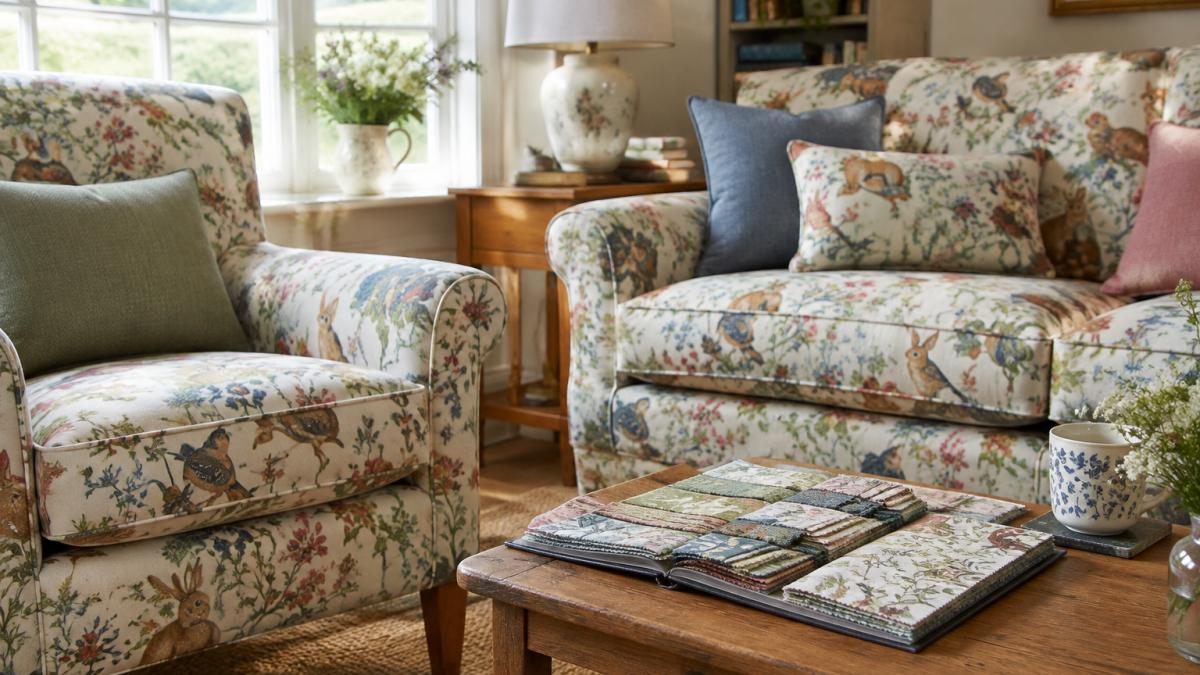
The Vintage Rose fabric in Blue & Stone is one of our original best sellers, and the simple colourway gives stunning impact. For something bolder, browse our flower print fabric in sage or sky blue. Both mix well with plains and suit cushions as readily as chairs.


Cotton upholstery fabric care comes down to three habits: vacuum weekly, blot spills immediately, and keep seating out of direct sun where you can. Rotate and plump cushions to spread wear evenly. Follow the maker's cleaning code, and test any product on a hidden area first.
Watch out: scrubbing a stain pushes it deeper into the weave. Blot, don't rub.
Always order a fabric sample before committing. Colour reads differently in your own light, and a swatch tells you more about texture than any screen. Measure your piece, add allowance for pattern repeat and seams, then add a little extra.
A simple planning checklist:
Choosing upholstery fabric is a balance of beauty and hard use, and getting it wrong is expensive. Aurina can help you narrow the field with personal shopping advice, access to custom fabrics and cushions, and one-off interior pieces made to order. Get started with Aurina and choose a cotton that suits your home for years, not seasons.
Yes, cotton upholstery fabric is a practical choice for most domestic furniture. It is breathable, soft to the touch and takes dye and print well, which is why it suits sofas, chairs and cushions in everyday living rooms. The key is choosing a tightly woven, heavier-weight cotton rather than a lightweight dress fabric. A dense construction resists marking and pilling far better, and a cotton and linen union adds extra strength for high-traffic pieces.
Look for a medium to heavy weight, roughly 250 to 400 grams per square metre, with a tight weave. Lighter quilting cotton is too thin for a sofa seat and will wear through quickly. Heavier canvas and duck are the most hard-wearing options, while printed cottons work well for cushions and occasional chairs. Always ask for the fabric weight and a Martindale rub count before you commit, and order a sample to feel the density for yourself.
A standard dining chair usually needs around 2 to 3 metres of 150cm-wide fabric, while a large armchair can take 6 to 8 metres. Pattern repeats matter: a design with a 64cm repeat needs extra allowance so the motifs line up across seams. Measure the piece, note the repeat, and add 10 to 15 per cent for waste. Ask your upholsterer to confirm the quantity before ordering, as running short mid-project is a common and costly mistake.
Regular vacuuming with a soft brush attachment removes dust before it works into the weave. Blot spills immediately with a clean cloth rather than rubbing, which can spread the stain and roughen the surface. For deeper cleaning, check the fabric care label and test any product on a hidden area first. Cotton can shrink, so avoid soaking it. Many printed cottons are best professionally cleaned, and keeping furniture out of direct sunlight slows fading and colour loss.
Comments will be approved before showing up.
