
Your Basket is Empty
Email shop@aurina.co.uk for bespoke advice

Quick Summary
Woven baskets for sustainable home storage are natural-fibre containers such as seagrass, rattan and willow wicker that can be repaired, re-used or passed on rather than thrown away. Choose one made from a renewable material, finished without heavy synthetic coatings and produced under fair conditions.
Last Updated: November 8, 2026
Woven baskets for sustainable home storage have moved well beyond the decorative corner of a living room. Plastic tubs fill landfill and ocean, and a handwoven basket made from a natural fibre can hold laundry, kindling, toys or post for years. This guide explains how to choose a natural-material basket that will last.
Woven baskets for sustainable home storage are a simple idea with a practical case behind them. Natural fibres such as seagrass, rattan and wicker are renewable plant materials, and a well-made basket can be repaired, re-used or passed on rather than thrown away. That is the core sustainability argument, and it is stronger than any single claim about a material being "green".
Natural baskets are often chosen for three reasons:
Not every basket is equally sustainable, though, and the rest of this guide shows you how to tell the difference.
Seagrass, rattan and wicker are the three natural materials you will meet most often. Seagrass is a grass-like fibre that is tightly woven and water-resistant, rattan is a climbing palm stem cut into lengths and bent, and wicker describes the weaving technique rather than a single plant. Each suits a different job in the home, and each carries a different sustainability profile.
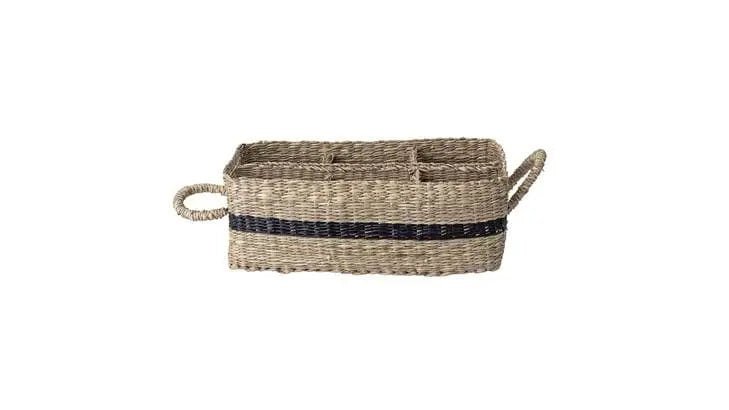
Our Seagrass Basket, at £29.95, is compartmentalised and measures 25.5cm long, 19cm wide and 9cm high. Its divided interior makes it useful for organising small everyday items.

Natural fibres differ, so it is useful to compare them on four points: how the plant is grown, how the fibre is processed, how long the finished basket lasts and what happens to it at end of life.
Seagrass. Seagrass grows in coastal and wetland habitats and is cut from established beds, so it does not compete with food crops for land. It is usually dried and woven without heavy chemical treatment, which keeps processing simple. The trade-off is that seagrass is a stiff, brittle fibre: it holds its shape well in a structured basket but can crack if it dries out completely or is soaked. It is best kept out of damp bathrooms and away from direct radiator heat. Untreated seagrass can be composted at end of life, but only if it has not been sealed with a plastic lacquer.
Rattan. Rattan is a fast-growing climbing palm, which makes it attractive on renewability. Harvesting can strip forest understorey if it is not managed responsibly, so sourcing matters more here than with seagrass. Rattan is steamed and bent into shape, which takes energy but produces a strong, rigid frame that carries heavier loads than seagrass. It is the better choice for logs, towels and bulky throws. A well-made rattan basket can last many years and be re-woven if a strand breaks, but varnished or painted rattan is harder to compost.
Wicker. Wicker is a technique, not a plant. It is most often woven from willow, which is grown as a managed crop and coppiced, cut back to the base so it regrows, making it one of the more renewable options. Willow wicker is flexible and repairable, but it is less water-resistant than sealed seagrass and will soften if left damp. Unsealed willow wicker composts well.
When comparing baskets, it helps to ask the seller what the material is, where it was harvested and whether the finish contains plastic lacquers.
The article compares how each of the three natural materials performs on the four sustainability points.
| Material | Renewability and sourcing | Durability and care |
|---|---|---|
| Seagrass | Cut from established beds; no competition with food crops | Holds shape well; can crack if dried out or soaked |
| Rattan | Fast-growing climbing palm; sourcing matters | Strong and rigid; can be re-woven if a strand breaks |
| Wicker (willow) | Managed crop, coppiced to regrow | Flexible and repairable; softens if left damp |
An "eco-friendly" label is a starting point, not proof. Look for a basket made from a natural material, finished without heavy synthetic coatings and produced under fair conditions.
Handwoven baskets are made by artisans working with traditional skills. Our Hand Woven Round Basket, at £39.95, is made by hand in Ghana, and its rounded form works equally well as a shopping basket, a beach bag or a loo roll holder. Its natural fibres bring practical storage and a softer feel to the home, while The Spotted Quoll offers another way to think about choosing decor made from materials that sit more lightly on the environment.
Our Small African Woven Baskets, at £19.95, and Large African Woven Baskets, at £26.95, are made by hand in Africa. No two are identical. The small ones average 28cm and the large ones 40cm in diameter, so expect slight variation. If you need a specific colour, email info@aurina.co.uk and we will help you choose from what is available.
Prices of Aurina woven baskets (£)
Rattan is strong and rigid, which makes it the right choice for heavier items, but size and load should drive your decision more than style. A large basket that the shelf cannot carry is a poor buy, however lovely it looks.
Measure the space first, including the depth of any cupboard or shelf. Then think about what goes in.
For a living room, a large rattan-style basket beside a sofa can hold throws and cushions without looking like storage. For a hallway, a smaller piece by the door keeps shoes or bags contained. Our Large African Woven Baskets suit the living room, while the smaller baskets fit a hallway or bedroom shelf.
A lid changes what a basket can do. It hides clutter, keeps dust off soft items and stops small things spilling out. For blankets and winter throws, a lidded basket keeps fabric clean between uses and stops pets claiming them.
For toys, paperwork and everyday clutter, choose a lidded basket with a closure you can lift with one hand. Avoid tight lids on baskets you use daily, because they become a chore to open and the clutter ends up on the floor anyway.
Lid type should follow the job, not the look. Three patterns cover most homes:
Match the basket to the space before you buy. Measure the shelf or cupboard opening, including the depth, and allow a couple of centimetres of clearance so the lid lifts without catching. A lidded basket that is 40cm across will not fit a 35cm shelf however useful it looks. You can browse the smaller woven baskets to find options that suit tighter spaces.

Think about weight as well as volume. A lidded basket full of blankets or toys can become heavy, so choose one with handles that are woven into the body rather than stitched on, and lift with two hands when it is full. For a child's room, a smaller lidded basket they can carry themselves is safer and more likely to be used.
Watch out: a lid that fits too tightly can trap damp in soft furnishings, so air blankets and throws before storing them for the season and keep lidded baskets out of damp cupboards.
Natural fibre lasts longest when it is kept dry and dusted. For more on choosing handmade woven pieces for living spaces, see our guide to handmade woven rugs. Vacuum the outside with a soft brush attachment once a month, and wipe with a barely damp cloth if something is spilled. Never soak a woven basket, since water weakens the fibres and encourages mould.
If a strand lifts or a weave loosens, act early. A small amount of natural fibre glue or a fresh length of cord can stop a small problem becoming a broken basket. Keep baskets away from direct radiator heat, which dries and cracks natural materials over time.
If you are buying your first basket, start with one clear job. The Seagrass Basket at £29.95 suits organised storage, the Hand Woven Round Basket at £39.95 can be used as a shopping basket, beach bag or similar, and the Small African Woven Baskets at £19.95 are an option for natural storage.

Subscribe to hear more about our baskets and sustainable home storage.
Seagrass, jute and rattan are natural plant materials often chosen for woven storage baskets. At Aurina, the seagrass basket is priced at £29.95 and the hand woven round basket at £39.95.
The Aurina seagrass basket is a compartmentalised design measuring 25.5cm long, 19cm wide and 9cm high, which makes it useful for organising small everyday items.
Look for specific details rather than general claims. Ethical makers usually name the region or workshop, explain who weaves the baskets and how they are paid, and describe the materials used. Aurina's small African woven baskets, priced at £19.95, and large baskets, priced at £26.95, are hand made for the business in Africa, so each one is individual and sizes vary slightly. Ask any seller for the origin, the weaver's involvement and the finishing process before you buy.
Well-made woven baskets are durable enough for everyday use when chosen for the right job. Hand woven pieces vary slightly in shape and size, which is part of their character rather than a fault.
Comments will be approved before showing up.
