
Your Basket is Empty
Email shop@aurina.co.uk for bespoke advice

Last Updated: October 14, 2026
Walk into any high street homeware aisle and you will find shelves stacked with items that look the part but tell you nothing about where they came from. That is exactly the problem British made homeware solves. When you buy a piece made here, you are buying something with a traceable story, a shorter journey to your door, and a level of finish that mass production rarely matches. This guide from Aurina covers what that actually means for your home, your wallet, and the makers behind the pieces.
The benefits stack up quickly once you look closely. You get durability that outlasts the trend cycle. You get money that stays in local economies rather than disappearing into distant supply chains. And you get the quiet satisfaction of owning something a person actually finished by hand. Below, we will show you exactly how to spot genuine British-made goods, what they really cost, and where to find them.
Spotting a genuine British-made item takes about thirty seconds once you know what to look for. The trick is knowing which marks mean something and which are decoration.
"Made in England" and "Made in the UK" are the phrases to look for. Terms like "designed in Britain" or "British brand" are not the same thing. A product can be designed here and manufactured overseas.
Check the country of origin on the label, the packaging, and the product page. Under UK government guidance on country of origin labelling, traders must not mislead shoppers about where goods are made, so a false claim is a legal problem, not just a marketing one.
For ceramics, look for the backstamp. Genuine bone china carries a maker's mark, and pieces hand-decorated in Stoke-on-Trent often say so directly.

A short conversation sorts the real from the rebadged. Ask these before you commit:
A confident retailer answers without hesitation. If the answer is vague, treat that as your answer.
British craftsmanship and homeware stand apart because of the hand-finishing that machines cannot replicate. In ceramics, that means motifs applied by hand following a template, so no two pieces come out identical.
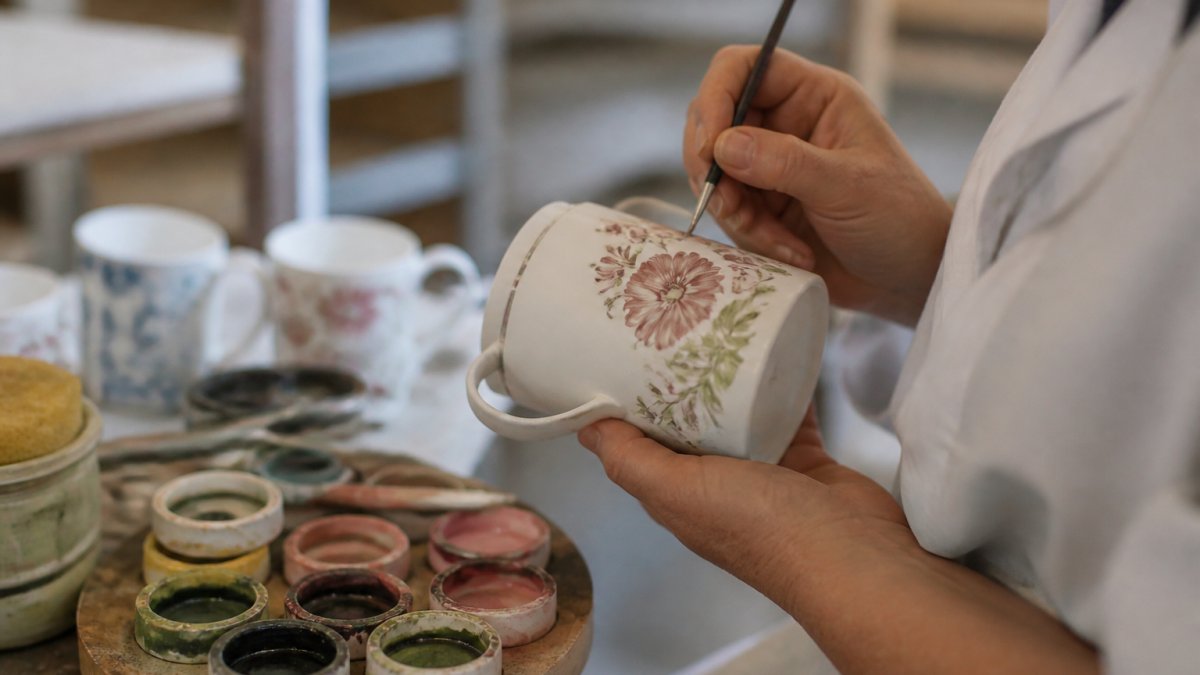
That slight variation is the point, not a flaw. Our own bone china is hand-decorated in Stoke-on-Trent, and we are upfront that not every piece will be the same. The region has made fine ceramics for generations, and that skill base is the reason the finish holds up.
A common mistake is assuming handmade means fragile. Good bone china is dishwasher and microwave safe, so it works for daily use rather than sitting behind glass.
Sustainable homeware is not only about materials. It is about distance, lifespan, and how many times you have to replace something.
A mug made and decorated a few hours away travels a fraction of the distance of one shipped from the other side of the world. Shorter journeys mean fewer emissions per item. Durable goods also mean fewer replacements over a decade, which is where the real environmental gain sits. A piece you keep for fifteen years beats three cheaper ones you bin every five.
Buying from independent makers tends to support smaller workshops rather than high-volume factories. That keeps specialist skills alive and keeps production local.
British made homeware costs more up front, and that is worth understanding rather than resenting. The price reflects hand labour, smaller production runs, and materials bought in modest quantities.
Here is how the value breaks down across a typical piece:
Aurina Dachsie Bone China Teapot – 6 Cup Capacity →
| What You Pay For | What It Means in Practice |
|---|---|
| Hand decoration | A person applies each motif, so no two pieces match |
| Smaller batches | Less waste, but no bulk discount on materials |
| Local labour | Wages that meet UK standards |
| Shorter supply chain | Fewer middlemen between maker and shelf |
| Durability | Fewer replacements over the item's life |
Compare that with a mass-market equivalent that costs less and lasts two or three years. Spread the cost of a well-made piece across a decade and the gap narrows sharply.
A hand-decorated bone china mug from our range costs £12.99. The Dachsie Small Bone China Mug is dishwasher and microwave proof, so it takes everyday knocks. You can shop the Dachsie Small Bone China Mug and see the finish for yourself.

For larger pieces, the maths still holds. The Aurina Dachsie Bone China Teapot brews six cups and is hand-decorated in Stoke-on-Trent at £54.99. A teapot that lasts a generation is not an expensive purchase. It is a cheap one spread over time.
Finding genuine British made homeware is easier when you shop with specialists rather than general retailers. Independents that build their range around UK makers tend to know exactly where each piece comes from.
Look for shops that name their workshops, show the backstamps, and can answer the origin questions above. Market stalls, craft fairs, and maker directories are good starting points. So are independent boutiques that curate rather than bulk-buy.
Buying remotely works well too. A good independent will talk you through colours, sizes, and finishes over the phone or by message, and will tell you honestly if something will not suit your space. For wallpaper and textiles, ask for a sample before you commit.
Our advice is simple: build a relationship with one or two shops you trust rather than chasing the lowest price across dozens of sites. The advice you get back is worth as much as the product.
If you are unsure where to start, browse our hand-decorated bone china range and see how a curated selection looks when every piece has a traceable origin.

The hard part is not finding British made homeware. It is slowing down long enough to check where things actually come from before you buy. Once you start asking the right questions, the cheaper alternatives stop looking like bargains.
At Aurina, we are an independent boutique built around British design-led pieces, from hand-decorated bone china to custom fabrics and made-to-order interior items. We offer personalised shopping advice, access to custom fabrics and cushions, and one-off pieces made to order, so you get something that fits your home rather than a shelf.
Subscribe to hear about new arrivals and the makers behind them.
For homeware, 'Made in Britain' indicates the product was substantially manufactured in the UK. This can mean the entire process, from design to finishing, happens here. For example, Aurina's bone china is hand-decorated in Stoke-on-Trent, supporting British manufacturing. It's worth checking the specific claims a brand makes, as the term isn't legally protected in the same way as some food labels.
Look beyond a simple 'Made in Britain' logo. Check the product description for details about where it was made, such as a specific town or factory. Brands that are proud of their British production often share this story. You can also ask the retailer directly about the manufacturing process. For instance, Aurina's product pages state their china is hand-decorated in Stoke-on-Trent, giving you a clear point of origin.
They can be. Buying locally made homeware often means shorter transport distances, which reduces the carbon footprint associated with shipping. It also supports local economies and traditional skills, contributing to a more sustainable model of production. For example, Aurina's bone china is made in Stoke-on-Trent, which keeps manufacturing local and supports British craftsmanship.
The higher price often reflects the true cost of skilled labour, quality materials, and smaller-scale production. Unlike mass-produced items, British-made homeware is often crafted in limited runs, with more hands-on work. For example, a hand-decorated bone china teapot from Aurina costs £54.99, a price that reflects the craftsmanship and the fact that each piece is unique. You're paying for durability and a story, not just the object.
Comments will be approved before showing up.